 Image: Secession, Vienna
The Secession in Vienna is presenting Onyeka Igwe’s 'No Archive Can Restore this Chorus of (Diasporic) Shame' from 12 June to 30 August 2026, bringing together two video works that examine colonial memory through the afterlives of an archive. The exhibition takes its title from the artist’s 2024/26 project and continues Igwe’s sustained engagement with materials and spaces left behind by imperial systems, including film stock, bureaucratic images and abandoned buildings.
According to the Secession, Igwe’s practice treats the colonial archive not as a stable store of knowledge but as a site of tension, opacity and unresolved violence. Her films and installations return to what is missing, suppressed or rendered inaudible, and the exhibition links that approach to the lingering effects of British colonialism in Nigeria. Rather than attempting restoration in a conventional sense, the work stages an encounter with historical dissonance and with what remains inaccessible in institutional records.
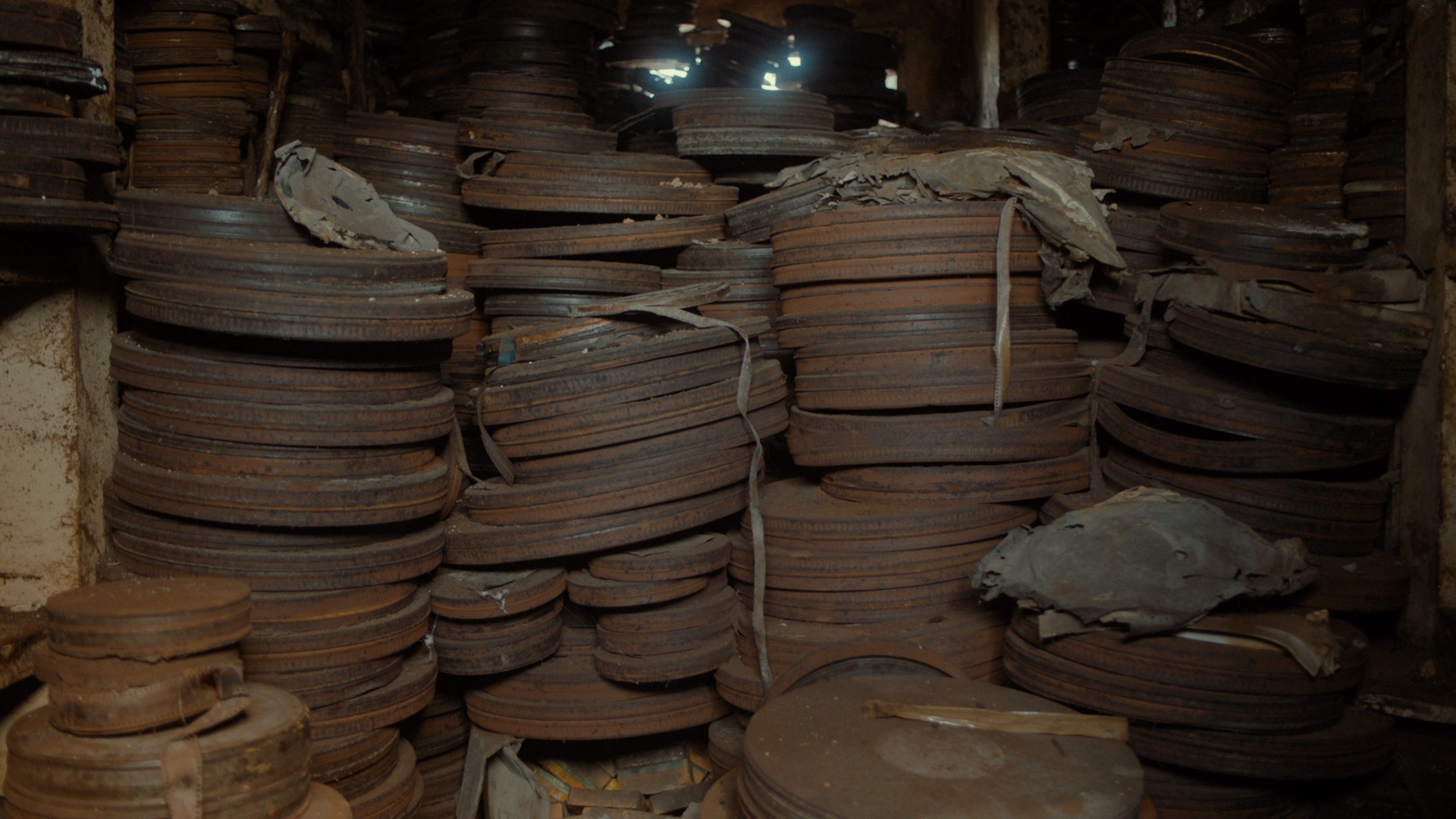
Installed in the upper floor of the Secession, the exhibition unfolds through two video works shown in close relation. One piece, presented at the window front, traces the aftermath of British colonial rule in Nigeria through the abandoned premises of the former Nigerian Film Unit in Lagos, once an important branch of the Colonial Film Unit’s propaganda apparatus. The building is now in ruins, and the source material notes that the footage stored there is difficult to access, both because of its physical decay and because of a broader reluctance to confront its contents.
Igwe addresses that material indirectly rather than restoring lost films. The video lingers on the building’s interiors, where dust, cobwebs and decaying files and film cans make the archive visible as something at once present and withdrawn. A lightbox installation titled 'anomalies and cobwebs' (2026) shows slides taken from the film and remounted years later, emphasizing how fragments can be re-read outside their original sequence. For the Vienna exhibition, the artist also developed a second, digitally generated video that reconstructs the Nigerian Film Unit building both inside and out.
The show also develops the sound component of the work. When Igwe presented the project in 2024 in the Nigerian Pavilion at the Venice Biennale, the soundtrack was accompanied by a black screen. In Vienna, the new digital video gives that composition a visual counterpart and presents the different sound layers through integrated subtitles. The exhibition text states that Igwe has, for several years, been concerned with making film and sound accessible to deaf audiences, and in this work the subtitles do more than transcribe audio: they become a visual element in their own right.
The soundscape draws on testimony, field recordings and archival fragments gathered in Nigeria and the United Kingdom. It incorporates Nnamdi Azikiwe’s inaugural speech, and it also revisits songs linked to the 1947 Egba women’s uprising against the colonial tax system, led by the Abeokuta Women’s Union under Funmilayo Ransome-Kuti. For those songs, Igwe found lyrics in her research but not the recordings themselves, so she and musician Tanya Auclair created a new choral composition performed by a 13-member a cappella ensemble. Drawing on the tradition of Sacred Harp singing, the arrangement distributes leadership across the group rather than centering one voice.
The title of the film was inspired by Julietta Singh’s 'No Archive Will Restore You' (2018), a hybrid work of essay, memoir and poetic theory. The Secession’s text underscores the title’s central claim: no archive, institutional or otherwise, can fully recover what has been lost. Onyeka Igwe was born in London in 1986 and lives there. The exhibition is curated by Jeanette Pacher, and a publication accompanies it.