 Image: Katherine Hubbard, The Great Room, exhibition view, Secession 2026. Photo: Iris Ranzinger
The Secession is presenting Katherine Hubbard’s 'The Great Room' from 12 June to 30 August 2026, a solo exhibition built around a five-year project that began in 2020, at the start of the Covid-19 pandemic. According to the institution’s exhibition text, Hubbard’s work developed alongside a period when her mother, Antonette Berger, was diagnosed with a form of dementia, and the resulting photographs document encounters between the two women shaped by grief, intimacy and disorientation.

The exhibition centers on Berger’s apartment on the first floor of a Victorian house that had belonged to her for more than four decades. Hubbard uses that space as the setting for a sequence of photographic meetings that emerge from repeated rituals and everyday interactions. The images, the Secession notes, hold together tenderness and confusion, while also registering the strain of a relationship under changing conditions. The apartment itself becomes more than a backdrop: it functions as a stage for the work and a framework through which Hubbard organizes looking, proximity and memory.
Hubbard’s project also marks a shift in her practice. The Secession describes 'The Great Room' as a point where the artist’s work becomes closely intertwined with her identity as a daughter, while still remaining rooted in her long-standing attention to representation and the power structures embedded in photography. In many images, Hubbard includes herself, often with a tripod and camera in view. That decision makes the act of picture-making explicit and resists the idea of an invisible observer. The exhibition text reads this as a refusal to leave her mother alone in the image.
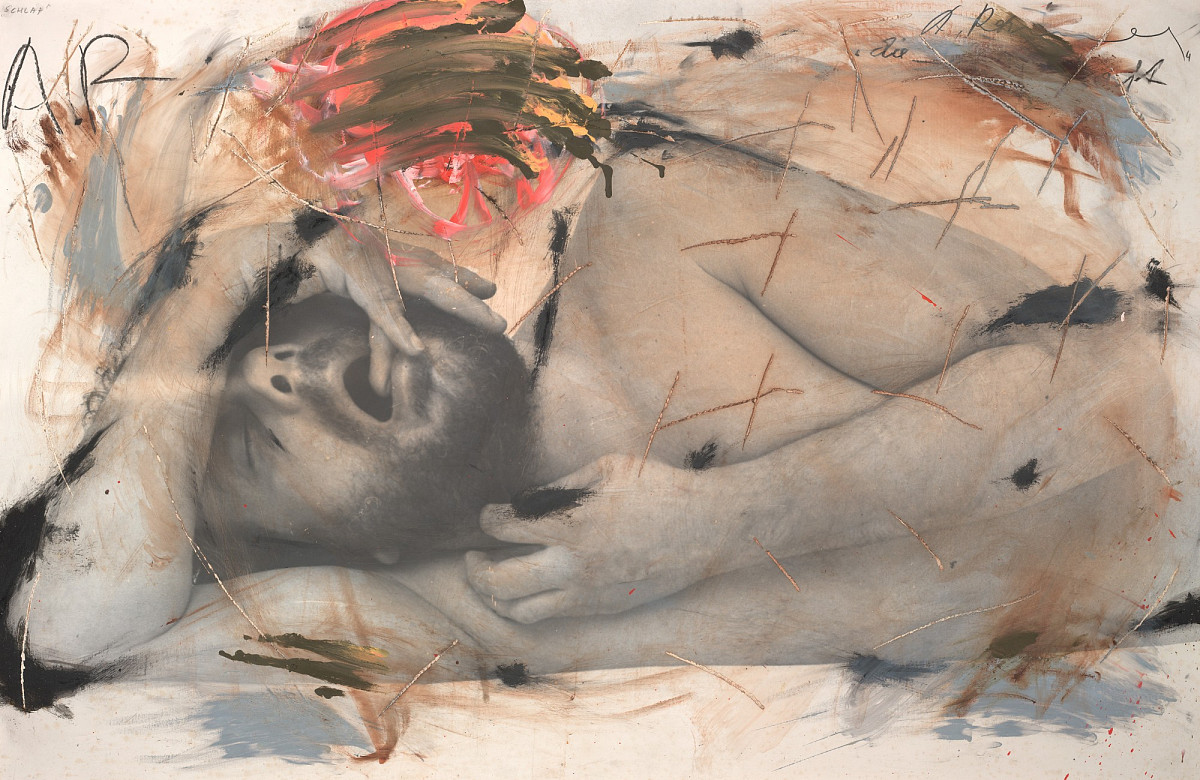
The project includes moments when Berger herself presses the shutter, further unsettling the usual subject-object relationship in photography. The exhibition presents this as a subtle redistribution of agency, with Berger appearing not as a passive subject but as an active participant. Alongside the photographs, Hubbard extends the work through cameraless pieces made in the darkroom, where she and her mother created contact prints by pressing their bodies directly onto photographic paper after coating themselves with Vaseline, turning touch into a physical trace.
Formally, the exhibition draws on instability. The Secession points to skewed viewpoints, fragmentary perspectives and mirrored images that multiply and overlap rather than settle into a single, coherent viewpoint. The title 'The Great Room' refers to the largest room in Berger’s apartment, once its most representative space, now marked by time and limited maintenance. Berger divided it with a temporary wall, separating her sleeping area from a storage space where objects and unresolved matters accumulated. That split is echoed in the exhibition’s architecture, where freestanding walls organize the gallery according to the apartment’s floor plan.
The exhibition was developed in collaboration with Studio Voltaire, London, where another chapter will be presented from 7 October 2026 to 10 January 2027. The two institutions commissioned new works by Hubbard as part of the partnership. The Secession also notes that a publication accompanies the exhibition and that an exhibition talk with Hubbard and Ulrike Müller took place on 11 June 2026, with a recording available online.