 Image: Museo delle Porcellane, Florence
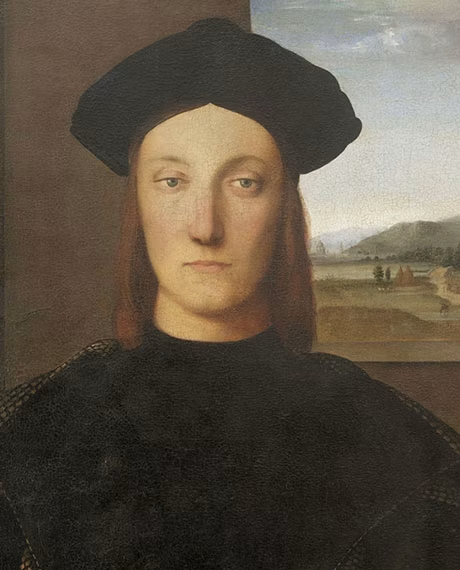
The Uffizi has drawn attention to Raphael’s 'Ritratto di Guidubaldo da Montefeltro', presenting the work as a key portrait in the collection at Palazzo Pitti in Florence. The museum’s notice focuses on the painting’s composed, unwavering gaze and its refined handling of status and character, underscoring the sitter’s identity as Guidubaldo da Montefeltro, a member of the Urbino ruling family.
According to the museum page, the portrait dates to around 1503–1504 and is held at Palazzo Pitti, within the Galleria Palatina, in the Sala di Ulisse. The work is an oil on panel measuring 70 by 51.6 centimetres and is inventoried as 1890 n.8538. The source identifies the artist as Raffaello, or Raphael Sanzio, born in Urbino in 1483 and active until 1520 in Rome.
The Uffizi description emphasizes the simplicity of the setting, which is defined above all by an open window looking onto a calm landscape of hills and small settlements receding into the distance, with the hint of a city on the horizon. That opening, together with the sitter’s dark clothing, helps shape the portrait’s restrained atmosphere. The text notes that the costume consists of a black garment and shirt, completed by a 'robone', a broad velvet jacket typical of Renaissance fashion, edged with a distinctive gold check pattern.
The museum also identifies the portrait’s symbolic colors as those of the Montefeltro family. It adds that these same colors appear in the clothing of Elisabetta Gonzaga in a pendant portrait in the same room, linking the work to a broader pictorial and familial context at Palazzo Pitti. The page places Guidubaldo within the Montefeltro dynasty, describing him as the son of Federico da Montefeltro and Battista Sforza and the last descendant of the family line, since he died without children and the title passed to his nephew Francesco Maria della Rovere.
The source further notes that Guidubaldo was a military leader and patron of the arts who left Urbino in 1502 during the advance of the forces of Pope Alexander VI, commanded by Cesare Borgia. His return in 1504 came after the election of Julius II della Rovere, his brother-in-law, allowing him to rule Urbino until his death in 1508. In the museum’s account, the portrait’s fixed expression and the pale face set against the black garment lend the sitter an official, severe presence.
The Uffizi page also situates the painting within Raphael’s artistic development, saying that the artist had absorbed Netherlandish painting, which he had studied since his formative years in Urbino. The museum notes that the dating of the work has been widely discussed by scholars, but is generally placed at the very beginning of Raphael’s Florentine period. A related work listed on the page is 'Ritratto di Elisabetta Gonzaga, duchessa di Urbino', also by Raphael, in the same room at Palazzo Pitti.