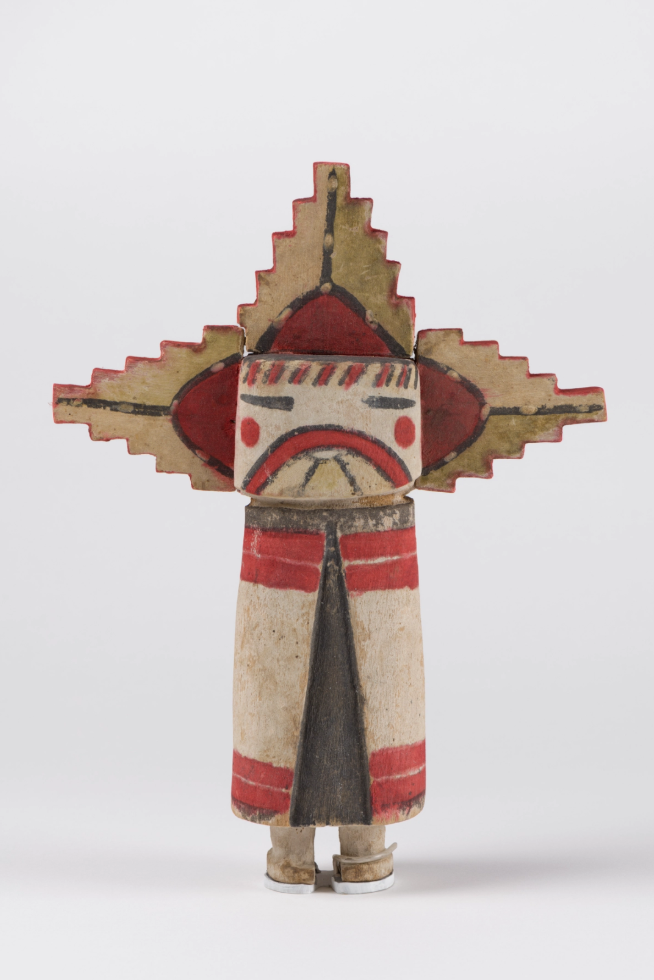
 Image: Brooklyn Museum, New York
The Brooklyn Museum opens Hopi Kachina Dolls: Blessings for a Balanced World on 2 October 2026, a presentation the museum describes as the first to approach the Hopi kachina doll tradition from the point of view of the people who receive the dolls rather than those who carve them. It is installed in the Elizabeth A. Sackler Center for Feminist Art on the fourth floor and stays up until 27 June 2027, with entry included in general admission.
Kachina dolls, or tithu, stand for the Katsinam, spirits that the museum describes as bringing much-needed moisture and holding the world in balance for the Hopi, an Indigenous tribe in the arid northeast of Arizona. The figures are cut from cottonwood and painted in a distinctive manner, and they are given chiefly to Hopi girls and women as offerings from the Katsinam themselves.
Fifty-three dolls drawn from the museum's own Indigenous art holdings sit inside a wider display of more than 120 works. The sequence follows stages of a Hopi woman's life: an infant girl first receives a plain flat figure, while the tithu that come later are more intricate and are bound up with prayer and with taking part in social dances. Baskets, jewelry and ceramics widen the account to other strands of Hopi women's making, including pieces produced over generations for community members, visitors and collectors alike. Newly filmed interviews give several of the participating artists room to describe their commitment to Hopi culture in their own words.
The exhibition was assembled by guest curator Colleen Lucero, managing director of the Hopivewat Learning Center, together with Nancy Rosoff, the museum's Andrew W. Mellon Senior Curator of Arts of the Americas, and Dare Turner, curator of Indigenous art, working with Grace Billingslea, a former curatorial assistant in the Arts of the Americas department. The museum names the Hopi Cultural Preservation Office and many members of the Hopi community as advocates and core contributors to the project.
An illustrated catalogue accompanies the show, carrying texts by Lucero, Rosoff and Turner alongside Kelley Hays-Gilpin and Diane Dittemore, plus interviews with Hopi artists and cultural leaders. The museum has also scheduled a day-long convening that borrows the exhibition's subtitle for 3 October, running from 11 am to 5 pm. Major funding is credited to the Henry Luce Foundation, with further support listed from the National Endowment for the Humanities, the National Endowment for the Arts and a number of private donors and foundations.