 Image: MASSIMODECARLO, Milan
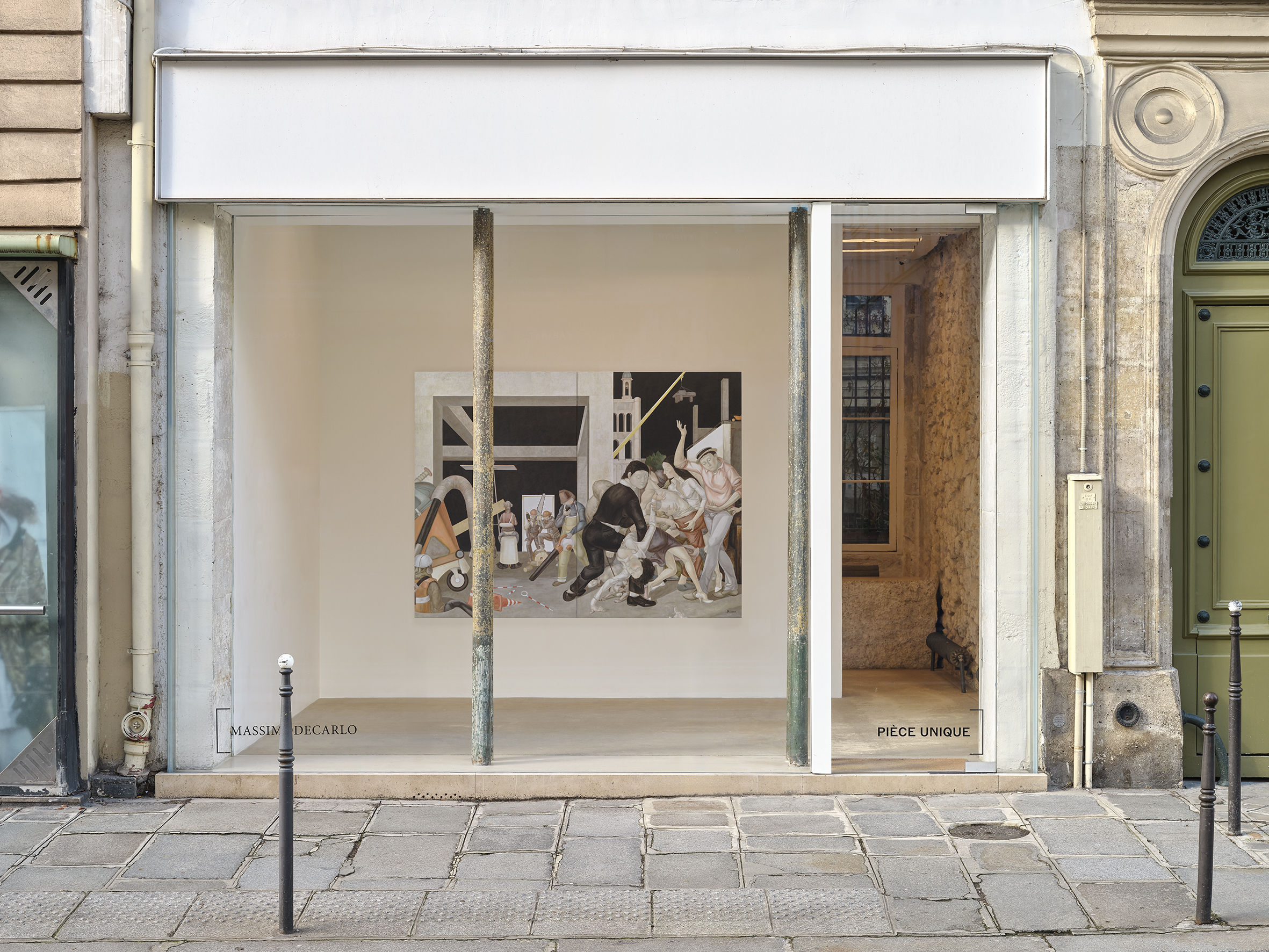
MASSIMODECARLO Pièce Unique is presenting ‘Rat-A-Hum-Tat-Tat-Rat-A-Hum-Tat-Tat’, Xiao Guo Hui’s first solo exhibition with the gallery. The exhibition, on view from 1 to 12 September 2026, consists of a single large painting made for the gallery’s street-facing window at 57 Rue de Turenne in Paris.
The work, also titled ‘Rat-A-Hum-Tat-Tat-Rat-A-Hum-Tat-Tat’ and dated 2026, is a diptych measuring more than two metres in width. Its title imitates the beat of music to which people dance, while the painting addresses the competing sounds of urban life. The presentation places the work directly against the activity of the street, where traffic, machinery and passers-by become part of the viewing experience.
The painting’s two sides set different forms of collective sound against one another. One section depicts machines associated with street maintenance and construction. The other shows a crowd dancing in a square based partly on Place Colette, across from the Louvre, which Xiao reconstructed from memory and invention. The dancers include professionals and amateurs, and are presented as absorbed in a shared activity.
The artist has connected the work to his experience of living in Paris’s Marais district for eight years with his wife, the artist and designer Chen Wen Qing. In the exhibition text, Xiao recalls the piercing beeps of street-cleaning trucks, leaf blowers and construction machinery. He also refers to Arthur Schopenhauer’s reputed distress at the sound of a sewing machine and considers how the philosopher might respond to the noise of a contemporary city. Rather than assigning a fixed meaning to the two groups, Xiao says he prefers to leave the interpretation suspended for viewers.
Xiao’s approach to painting also contrasts with the mechanical sounds depicted in the work. Trained in oil painting, he later turned to a combination of egg tempera and fresco, studying the techniques described in Cennino Cennini’s ‘Il Libro dell’Arte’. He prepares his own linen supports, grinds pigments by hand and builds surfaces through multiple layers. The resulting process draws on pre-Renaissance European painting traditions while retaining visible traces of manual work.
Costume is another central element of the composition. Chen Wen Qing designs and sews the clothing worn by each figure, with the couple adjusting the colour, cut and character of the garments together. The exhibition text describes dress as a means of distinguishing each person, recalling the role of clothing in paintings by artists including Sandro Botticelli and Piero della Francesca.
Born in China in 1969, Xiao Guo Hui is a Canadian artist based in Fontainebleau, France. He graduated from the Guangzhou Academy of Fine Arts in 1993, moved to Canada with Chen Wen Qing in 2001 and settled in France in 2015. MASSIMODECARLO Pièce Unique, which opened in a historic building at 57 Rue de Turenne in February 2021, runs a programme of single-work exhibitions designed to be visible through its glass window day and night. ‘Rat-A-Hum-Tat-Tat-Rat-A-Hum-Tat-Tat’ remains on view through 12 September 2026.