 Image: Frist Art Museum, Nashville
Nashville’s Frist Art Museum is presenting ‘An Indigenous Present’, a rotating exhibition that foregrounds contemporary Indigenous abstraction and remains on view through Sept. 27 in the museum’s upstairs gallery. The show, organized by curator Jenelle Porter and artist Jeffrey Gibson, brings together works that expand ideas of Indigenous art beyond direct or literal cultural reference.
The exhibition fits the Frist’s longtime model of presenting temporary exhibitions rather than a permanent collection. In the museum’s recent programming, that structure has allowed curators to build conversations across multiple exhibitions over time. ‘An Indigenous Present’ follows earlier Frist presentations including Gibson’s 2023 solo exhibition ‘The Body Electric’ and the 2019 exhibition ‘Hearts of Our People: Native Women Artists’, both of which helped lay groundwork for the questions the new show raises about identity, abstraction and Indigenous artistic practice.
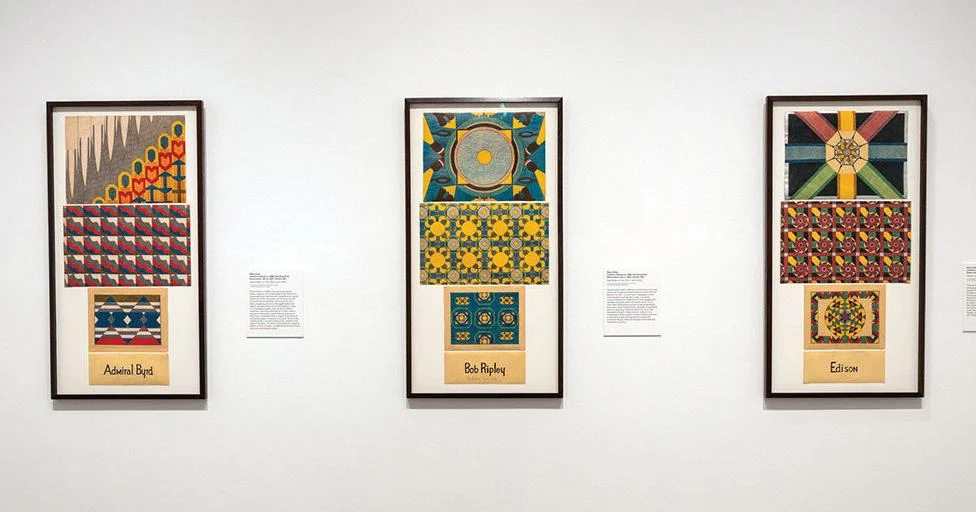
Among the most prominent artists in the exhibition is Mary Sully, whose multipanel works on paper, called ‘Personality Prints’, appear repeatedly throughout the installation. Sully is now regarded as a foundational Indigenous artist, though her work was not widely seen by the public for decades after her death in the mid-1960s. Born on the Standing Rock Reservation in South Dakota in 1896, she left behind drawings that were later found by her great-nephew, historian Philip Deloria, in the early 2000s. Her work has since attracted major museum attention, including a solo exhibition at The Metropolitan Museum of Art in 2024.
At the Frist, Sully’s pieces include ‘Edison’ and ‘Amelia Earhart’, works that combine abstract forms, printed names and carefully arranged imagery in ways that invite multiple readings. The article notes that ‘Edison’, made sometime between the late 1920s and early 1940s, features a colored-pencil drawing of an abstract shape that may suggest a Dakota star quilt, while also evoking a pinwheel pattern in primary colors. ‘Amelia Earhart’ includes a circle framing silhouetted figures and visible pin marks, evidence that the work was not always treated with museum-level care.
The exhibition also highlights Cree photographer Kimowan Metchewais, whose multimedia works appear at various points in the galleries. Metchewais died in 2011 at age 47 from a rare brain tumor, leaving behind a body of work described as both earthy and fragile. The Frist includes ‘Ghost Dancer’ from 1998, made with photo paper, watercolor, paint and chalk, as well as a 2002 work titled ‘Chief’s Blanket’, which uses bold stripe patterns and sections held together with tape.
In a curator interview quoted in the source article, Gibson says the exhibition’s artists were selected because they push traditional forms of cultural abstraction into new territory without severing ties to their origins. That framework is central to the exhibition’s structure: it presents Indigenous artists not as singular representatives of identity, but as makers who expand abstraction on their own terms.
‘An Indigenous Present’ opened with an opening reception on June 25 and continues through Sept. 27 at the Frist Art Museum, 919 Broadway, Nashville.
!['Shimmer: Dreaming the Posthuman' to Open at the Frist Art Museum[f1][f2]](/uploads/newsletter-12548-0e30af0095de.jpg)