 Image: Nasher Museum of Art, London
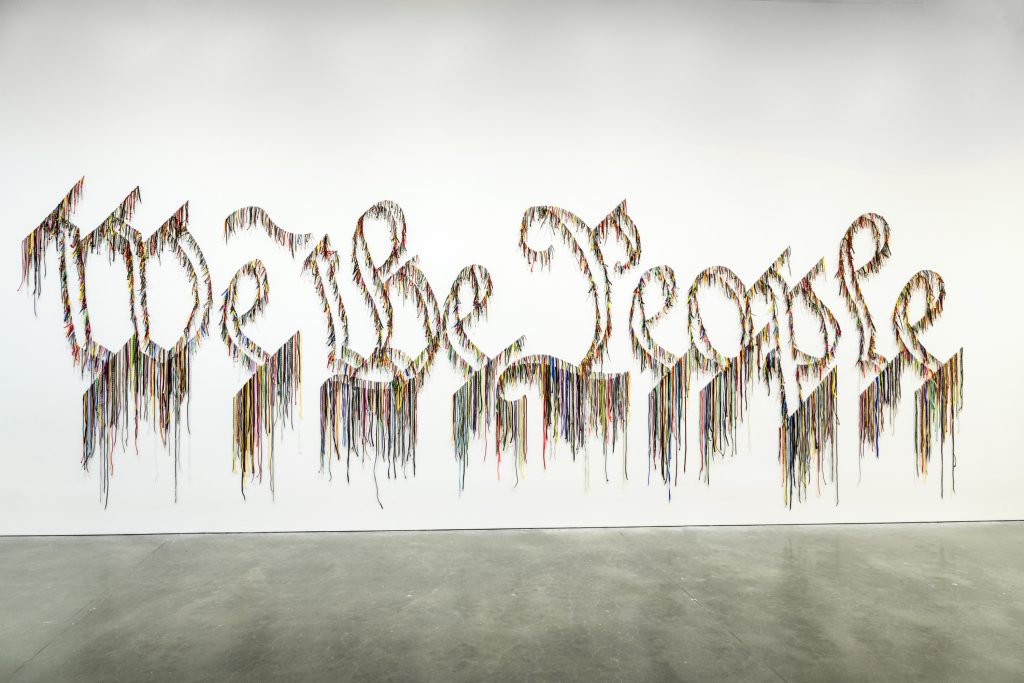
Nari Ward’s monumental installation ‘We the People’ will go on view at the Nasher Museum of Art at Duke University in Durham, North Carolina, on August 27. Made from thousands of shoelaces, the 2011 work will remain in the museum’s Great Hall through January 3, 2027, where it will examine democracy, belonging and participation through one of the most recognisable phrases in American civic life.
The installation spells out “We the People” in colourful shoelaces, transforming an everyday material into a large-scale communal statement. The work measures 96 by 324 inches (243.8 by 823 centimetres). The shoelaces, described by the museum as carrying traces of individual lives, form a collective image that points toward ideas of community and shared responsibility.
‘We the People’ is part of Ward’s longstanding practice of repurposing ordinary materials to uncover personal and social histories. At the Nasher, the work is presented as an invitation to consider who is included in the nation’s democratic ideals and how those ideals continue to change. Its use of a familiar civic phrase places questions of national identity and participation within the physical space of the museum.
The presentation is also connected to a concurrent display of historic copies of the Declaration of Independence, which opens at the Nasher on September 24 and runs through January 3, 2027. That exhibition features three early printed versions of the document on loan from the David M. Rubenstein Americana Collection, including an 1818 engraving by Benjamin Owen Tyler, an 1819 edition published by John Binns, and an 1823 Stone Declaration engraved by William J. Stone.
Together, the two presentations form part of ‘We the People: A Duke & Durham Initiative’, a programme marking the 250th anniversary of the signing of the Declaration of Independence through public events examining the nation’s evolving identity. The museum’s related exhibition ‘Turn the volume up!’—on view from August 27, 2026, to July 11, 2027—considers how artists, activists and ordinary people have used speech, protest, documentation and organising to shape public life. It is housed in the Brenda La Grange Johnson and Heather Johnson Sargent Pavilion.
The Nasher says its contemporary collection, built since 2005, has focused on amplifying historically underrepresented voices and includes artists from North Carolina, the United States and internationally. ‘We the People’ is organised by the Nasher Museum and presented courtesy of the Speed Art Museum in Louisville, Kentucky. Ward developed the work in collaboration with The Fabric Workshop and Museum in Philadelphia; the installation is part of the Speed Art Museum’s collection.