 Image: Gerhard Marcks House, Bremen
The Gerhard-Marcks-Haus in Bremen is presenting ‘Gerhard Marcks. Musiker und Dichter’, an exhibition devoted to the artist’s representations of music and poetry. The presentation brings together sketches of musicians with sculptures, prints and woodcuts developed from Marcks’s engagement with performance and literature. It remains on view through 20 September 2026.
The exhibition focuses on a less immediately familiar dimension of Marcks’s practice: his sustained observation of musicians in concert. Although Marcks described himself several times as a “music ignoramus,” the museum records that he attended concerts regularly and watched performers closely. For a sculptor who worked through drawing, the concentration and extreme physical tension of musicians offered a compelling subject.
The process began with small sketches made during performances. These rapidly produced studies captured musicians in action, recording their postures and gestures on paper. Marcks later developed some of these observations in his studio as three-dimensional works and graphic compositions, extending a fleeting moment of performance into sculpture and print.
Among the works identified by the museum is ‘Sitzender Geigenspieler’ from 1973, a bronze that exemplifies Marcks’s interest in the seated instrumentalist. The exhibition’s emphasis on the movement from live observation to finished work allows visitors to compare the immediacy of the sketches with the more deliberate forms of the resulting sculptures and graphic works.
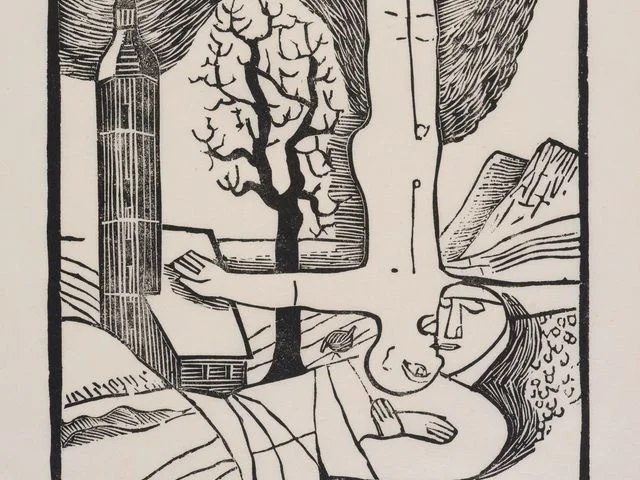
The presentation also considers Marcks’s relationship to poetry through a group of woodcuts. In these works, the artist drew extensively on his interest in Greece, including ancient themes and Greek mythology. The museum describes the strict clarity associated with Archaic art as an important resonance in this part of his work, linking the woodcuts to a broader engagement with classical sources.
Marcks’s interest in woodcut belongs to a larger graphic practice that developed alongside his sculpture. The Klassik Stiftung Weimar notes that Walter Gropius appointed Marcks to the Bauhaus in 1919, where he directed the school’s ceramics workshop until 1925. During that period, Marcks also continued to work as a free artist, drawing and sketching people, animals and landscapes. His friendship with Lyonel Feininger, who led the Bauhaus print workshop, encouraged Marcks’s exploration of the woodcut, which became a significant part of his oeuvre.
The Gerhard-Marcks-Haus, located at Am Wall 208 in Bremen, is dedicated to the artist and presents exhibitions alongside research, educational work and its collection. The museum is open Tuesday to Sunday from 10 a.m. to 6 p.m., with extended hours until 9 p.m. on Thursdays. ‘Gerhard Marcks. Musiker und Dichter’ can be seen at the Bremen museum until 20 September 2026.