 Image: M. K. Čiurlionis National Art Museum, Kaunas
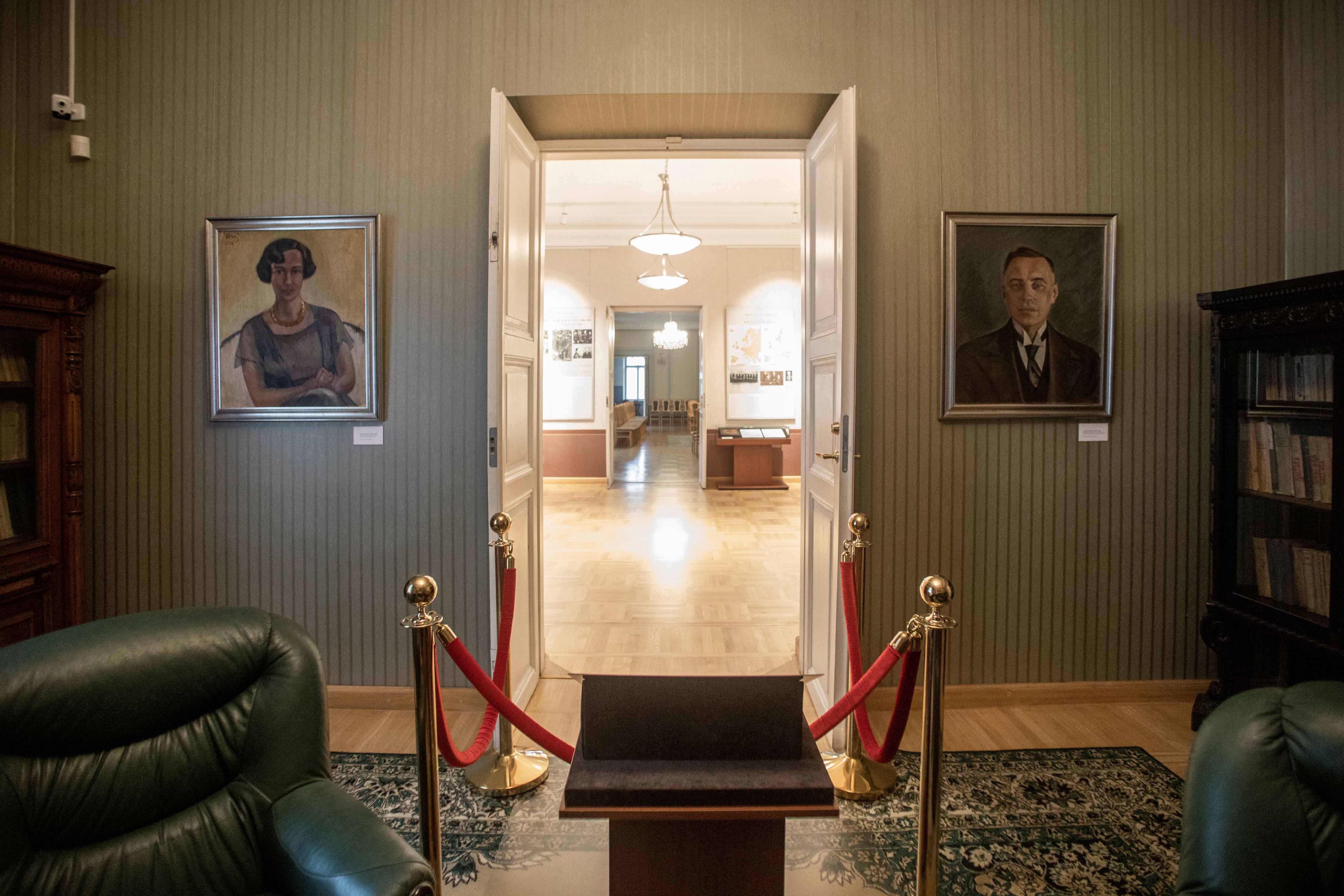
Two portraits painted in 1936 by Lithuanian artist Justinas Vienožinskis have been installed in the interior of the Historical Presidential Palace of the Republic of Lithuania in Kaunas. The paired paintings depict Jadvyga Tūbelienė (1891–1988) and Juozas Tūbelis (1882–1939), and have been transferred to the M. K. Čiurlionis National Museum of Art on a long-term deposit from the collection of Dr Jaunius Gumbis. The account of the works was published on 22 August by Genovaitė Bartulienė, head of the museum’s Fine Arts Department.
The works are being presented as examples of interwar Lithuanian representational art and as documents of the period’s political and social culture. Their placement in the Historical Presidential Palace, a branch of the M. K. Čiurlionis National Museum of Art, connects the portraits with the institutional and political setting in which Juozas Tūbelis served as a prominent state official.
Tūbelis’s portrait measures 80.5 by 68.5 centimetres and is an oil painting on canvas. According to the museum’s presentation, Vienožinskis uses a restrained, schematic composition to emphasise Tūbelis’s public identity as a long-serving politician, prime minister and governor of the Bank of Lithuania. The companion portrait of Tūbelienė has the same dimensions and medium, but adopts a different approach, with more fluid modelling, a softer palette and a less formal arrangement.
The contrast between the two images reflects two forms of public representation. Tūbelis appears through the authority associated with state office, while Tūbelienė is characterised by elegance, individuality, education and social standing. The museum also identifies her as an active supporter of the arts who attended exhibitions, provided financial assistance to younger artists and helped them obtain scholarships abroad. Such support was particularly significant for Vienožinskis, who sought broader European opportunities for his students.
The relationship between the Tūbelis and Vienožinskis families extended back more than three decades before the portraits were painted. Tūbelis and the artist, both from the Rokiškis region, knew one another from their time at the Mintauja Gymnasium. Vienožinskis later encountered Jadvyga Chodakauskaitė—who became Tūbelienė—in St Petersburg, where they belonged to the same circle of Lithuanian intellectuals and artists, including Paulius Galaunė, Adelė Nezabitauskaitė-Galaunienė, Kajetonas Sklėrius and Elena Sklėrienė.
The portraits also intersect with a complicated episode in the artist’s professional and family life. After a student strike at the Kaunas School of Art, which Vienožinskis had founded, he was dismissed in 1929. Tūbelis was then head of the government, and his position, expressed through the Ministry of Education, was relevant to questions concerning the school and its financing. Vienožinskis returned to teach there in 1935, after becoming chairman of the newly established Lithuanian Artists’ Union.
The same period brought a political tension into the artist’s personal circumstances. While painting the official portraits, Vienožinskis sought Tūbelienė’s help on behalf of his sister Liuda Purėnienė, the first woman lawyer in the Baltic states, a member of parliament and an active social democrat who opposed the policies of Antanas Smetona and Tūbelis. Museum materials describe the paired works as objects through which the personal relationships, cultural networks and political circumstances of interwar Lithuania can be viewed together.
Vienožinskis was among the most influential art teachers of the interwar period; the museum lists Antanas Samuolis, Antanas Gudaitis, Augustinas Savickas, Viktoras Vizgirda and Vytautas Kazimieras Jonynas among his students. The account draws on Ingrida Jakubavičienė’s study of the couple, published in Vilnius in 2020, and on the 1970 edition of Vienožinskis’s articles, documents and letters compiled by Irena Kostkevičiūtė.