 Image: Villa Zanders, Bergisch Gladbach
The Kunstmuseum Villa Zanders in Bergisch Gladbach is presenting more than 100 prints by James Ensor in ‘James Ensors fantastische Welten. Druckgraphik aus der Sammlung Quinensor’, an exhibition focused on the Belgian artist’s printmaking and its shifting visual language. The presentation runs from 31 May to 15 November 2026 and includes numerous hand-coloured examples from the Quinensor collection in Ostend.
Ensor (1860–1949) is known for expressive images of masks, grotesques and fantastical figures, as well as for compositions marked by irony and social allusion. The museum describes his work as resistant to conventional stylistic classifications associated with the 19th and 20th centuries. The exhibition is organised thematically, allowing visitors to encounter a range of subjects and motifs across his artistic world.
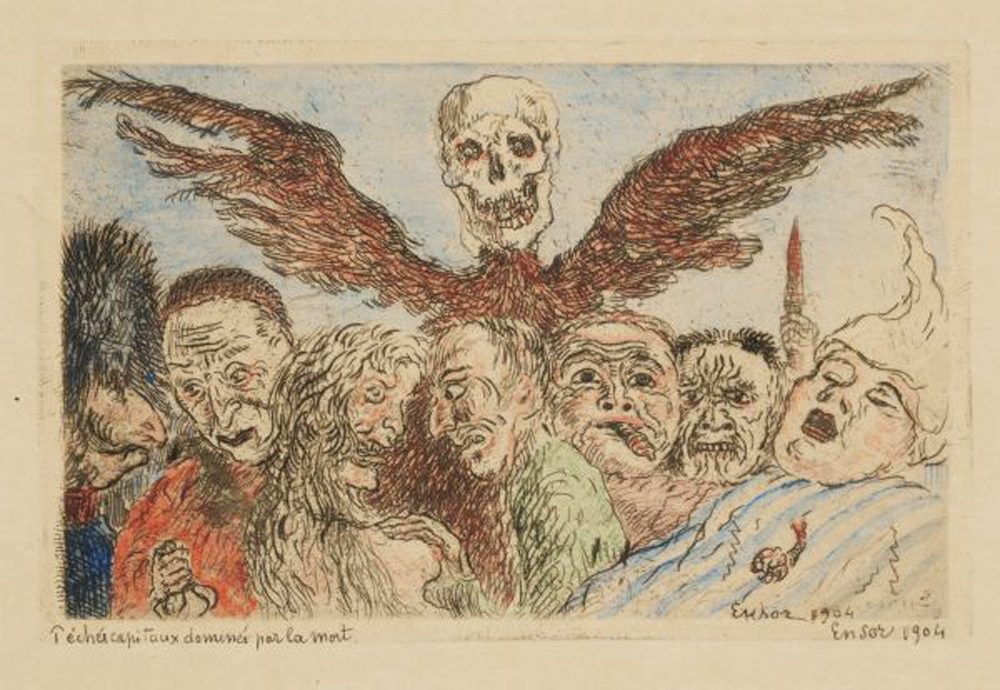
The presentation concentrates on two principal phases of Ensor’s printmaking, from 1886 to 1889 and from 1895 to 1899. Particular attention is given to the artist’s practice of hand-colouring, which the museum identifies as an important element in intensifying the meaning of his images. Among the works listed are ‘Die Todsünden vom Tode beherrscht’ (1904), ‘Der Einzug Christi in Bruessel’ (1898), ‘Boote am Strand’ (1888), ‘Der Pisser’ (1887), ‘Liebesgarten’ (1888) and ‘Mein Porträt als Skelett’ (1889).
The Quinensor holdings were assembled in Ensor’s home city over the past 25 years. According to Villa Zanders, the collection gives the public an opportunity to examine the artist’s graphic oeuvre in depth and follow the development of his printmaking. The museum places this work within Ensor’s broader role as a formative precursor of modern art, whose masks and other recurring themes continue to attract both museum audiences and artists.
Dr. Ina Dinter is the exhibition’s curator, with Maike Sturm providing curatorial assistance. Dinter has led Kunstmuseum Villa Zanders since 2024 and completed her doctoral research in 2015 on Ensor’s comparatively little-studied late work. The exhibition is supported by North Rhine-Westphalia’s Ministry of Culture and Science.
The accompanying programme includes lectures by Dinter on 25 June and 8 October. The first, ‘Ensor als Puppenspieler. Tanz, Theater und Inszenierung in der Kunst James Ensor’, examines theatrical and staged elements in his work, including masks, dance motifs and narrative still lifes. The October lecture, ‘In meinem Werk nehme ich eine große Einheit wahr.’ Wiederholung und Experiment im Spätwerk James Ensors, addresses repetition and experimentation in his later work, with particular attention to self-portraits and the ‘Liebesgärten’ series. A curator-led tour is scheduled for 23 July, while public tours are listed for 14 June, 5 July, 30 August and 13 September.
Family and access programmes are also planned, including a flashlight tour titled ‘Nachts im Museum: Ensors Spukgestalten’ on 30 October, workshops, and sessions for parents with babies and people with dementia. Kunstmuseum Villa Zanders is located at Konrad-Adenauer-Platz 8 in Bergisch Gladbach and is open Tuesday and Friday from 2 to 6 p.m., Wednesday and Saturday from 10 a.m. to 6 p.m., Thursday from 2 to 8 p.m., and Sundays and public holidays from 11 a.m. to 6 p.m.