 Image: Xavier Hufkens, Brussels
Nicolas Party is back at Xavier Hufkens in Brussels with 'Toile d’araignée', his fourth exhibition with the gallery. The presentation runs until 25 July at St-Georges and brings together five distinct groups of new works arranged as a sequence of rooms rather than a linear narrative.
According to the gallery’s materials, the exhibition is built around themes of transition and transformation, with recurring motifs that include water, bridges, double portraits, dead fish, spider webs and trees. Party uses these subjects across separate spatial sections, allowing visual and thematic correspondences to emerge between one room and the next.
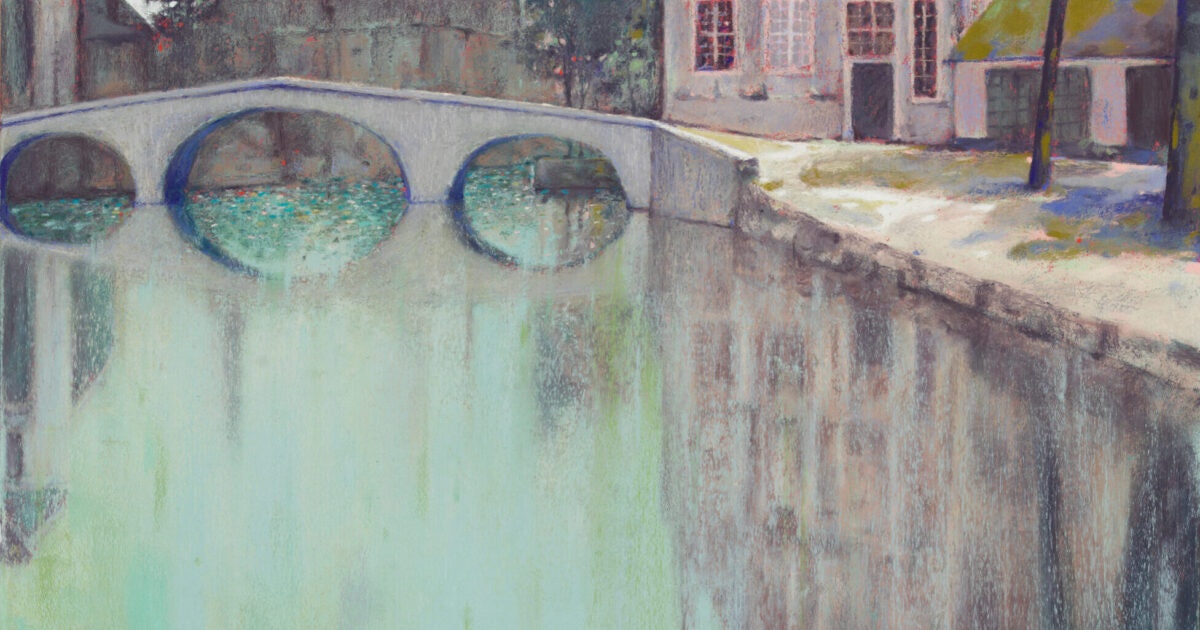
The opening group takes Georges Rodenbach’s 'Bruges-la-Morte' (1892) as its point of departure. Xavier Hufkens says the works draw on images from the Belgian Symbolist novel, which incorporated photographs into the text, while shifting attention away from architecture and toward reflection, doubling and water. Bridges appear as stabilising forms within these compositions, setting up a contrast between passage and fixation, while the reflected image introduces the idea of the double.
The gallery’s text also places these Bruges paintings within a wider chain of reinterpretations that includes Pierre Boileau and Thomas Narcejac’s 'D’entre les morts' (1954), Alfred Hitchcock’s 'Vertigo' (1958) and Ingmar Bergman’s 'Persona' (1966). In the exhibition’s account, these references inform Party’s interest in unstable identity, repetition and the space between appearance and disappearance.
A double portrait on the ground floor extends that concern into figures that are described as human but destabilising within the show’s largely architectural and landscape-based sequence. From there, the exhibition moves through dead fish, a motif Party has used recently and one that the gallery relates to Dutch nature morte and to precedents by Francisco de Goya and Pierre-Auguste Renoir. The fish are shown in indeterminate settings, without a recognisable environment, so that the works remain suspended between material presence and symbolic meaning.
On the upper floor, spider webs introduce another register of fragility and duration. The exhibition text notes that the webs are depicted at daybreak, when dew briefly makes their structure visible, and frames them as temporary constructions that are made, undone and rebuilt. That cycle is linked to pastel as a medium, with the web serving as a metaphor for labour, delicacy and the act of inscription.
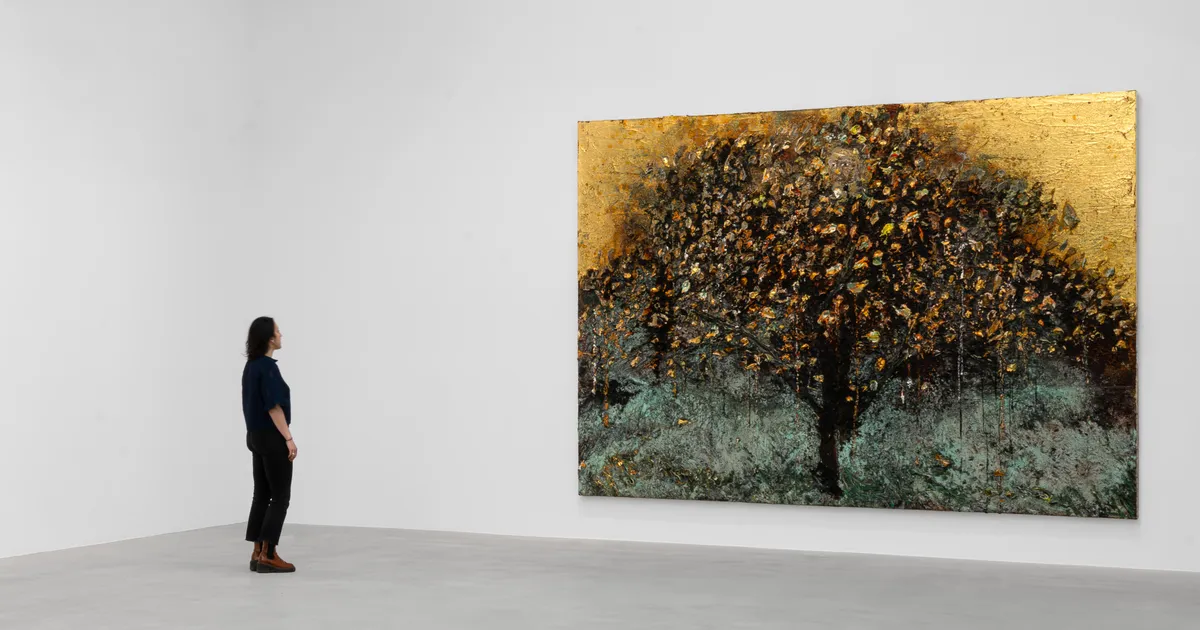
The lower gallery is devoted to treescapes that differ from the compressed horizons of the Bruges works. Here, Party adopts a lower perspective and gives more space to the sky, while soft green and gold tones replace the sharper coloration of earlier paintings. Xavier Hufkens describes the tree as a symbolically charged motif linking earth and sky, and presents the sequence as part of an exhibition that keeps forms in motion rather than settling them into a fixed reading.