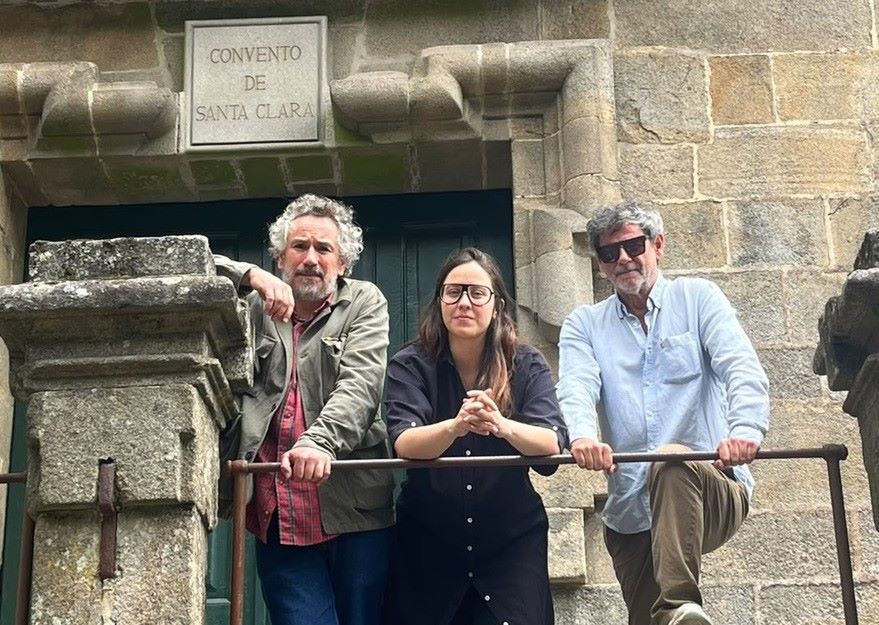
 Image: Misha Bies Golas, Manuela Pereira and Juan de Nieves at the Convento de Santa Clara, Santiago de Compostela
An interview with artist Misha Bies Golas and curator Juan de Nieves examines the artist’s exhibition at the Galicia Contemporary Art Center (CGAC) in Santiago de Compostela, focusing on how existing objects, images and cultural references become the basis for new work. Published by Tempos Dixital on 19 August 2026, the conversation accompanies the presentation of ‘Misha Bies Golas’ at the Spanish institution.
The interview describes the exhibition as the most extensive individual presentation of Bies Golas’s work to date, a characterization made by interviewer Manuela Pereira. De Nieves, who curated the show, places the artist’s practice in relation to Douglas Huebler’s 1969 statement, “The world is full of more or less interesting objects; I do not wish to add any more.” For De Nieves, Bies Golas does not simply alter the formal appearance of pre-existing artefacts. Instead, he repositions them so that they can be understood critically in the present.
De Nieves describes observation as the artist’s initial method: Bies Golas looks closely at objects, situations and scenes from everyday life as well as at works and artefacts associated with art history. He links the verb “to notice” with a second meaning, that of repairing or correcting, arguing that the artist’s attention can become a form of analysis and critical engagement with reality. The curator connects this approach to conceptual practices that challenged established artistic forms through language and other procedures.
Bies Golas says his process combines deliberate or affective choices with more spontaneous associations. An object that attracts his attention may connect in his mind with literature, cinema, theatre or visual art that he has studied over the years. He also identifies a private, anecdotal dimension in many of his works, describing the emergence of a piece as the result of interactions between these cultural references, observed objects and personal narratives.
A central example discussed in the interview is ‘Sombras’, a work made for CGAC’s Dobre Espazo. De Nieves characterizes it as an essay in space, related to earlier interventions in Loeches and at the Museo Oteiza, and points to its theatrical dimension. Bies Golas traces part of his interest in staging and material transformation to the puppeteers and street performers he encountered growing up in Lalín, Galicia.
The artist recalls the resourcefulness of puppet theatre, where discarded materials such as wood and scraps could be reused to construct figures and portable stages. He also cites pre-cinematic devices, including zoetropes, shadow theatres and rudimentary forms of animation, as sources of interest. These practices, he says, demonstrated how limited means could generate a distinct sense of time, communicate ideas and encourage critical thought, while also creating a community around public performance.
Bies Golas further discusses family objects, photography and the idea of the souvenir as ways of learning about the world. He recalls a grandfather’s carefully kept farmer’s knife and another grandfather’s practice of making medals from coins, transforming ordinary objects into valued personal artefacts. Photography, meanwhile, serves for him as a notebook or a means of taking notes on the world—an instrument for recording things that could not otherwise be carried home. The interview presents these observations and references as part of the material and intellectual territory of his exhibition at CGAC.