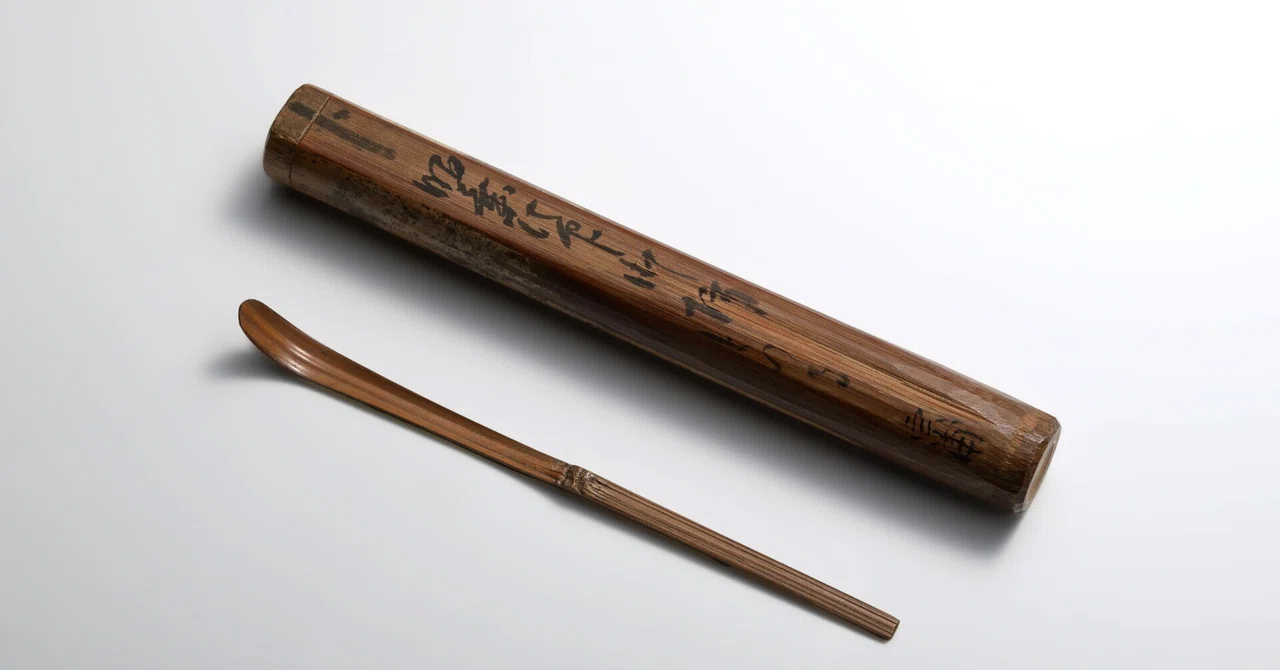
 Image: Fujita Art Museum, Osaka
The Fujita Art Museum in Osaka is currently featuring an Edo-period tea scoop titled '吾友' ('My Friend'), a work that links tea culture, calligraphy and personal exchange in 17th-century Japan. The museum’s online introduction places the object in its 'Fujita Art Museum 100 Selections' series, presenting it as a close look at a single item from the collection rather than a broad thematic survey. The tea scoop is credited to Kobori Enshu, the daimyo and tea master whose influence extended across tea, architecture and garden design.
According to the museum, '吾友' was made by Enshu as a gift for Shōka Dō Shōjō, better known as Shojō, a cultural figure associated with calligraphy, painting and tea. The scoop is described as a white-bamboo piece with an unusual form and a node positioned lower on the shaft, details that underscore the individuality valued in tea utensils made or used by tea practitioners themselves. In the museum’s account, the object survives not simply as a utensil, but as evidence of how social ties were preserved and transmitted through tea.
The title '吾友' is tied to another figure in the circle: the Zen monk and poet Kogetsu Sogan, who used the name Ketsushinshi. The museum says a poem inscribed on the scoop’s accompanying bamboo container provided the source for the name. In that poem, the phrase '吾友' refers to bamboo itself, while also resonating with the friendship among Enshu, Shojō and Sogan. The museum’s text presents this as a case in which a personal gift, literary reference and tea practice all converge in one object.
The museum also notes that the set includes a letter of thanks from Shojō to Enshu, preserved as an attached hanging scroll. In the letter, Shojō expresses gratitude for receiving the tea scoop and an accompanying pair of feather dusters, and says the gifts revived him at a time when age and social distance had left him feeling weakened. The museum provides a partial transcription and modern Japanese paraphrase of the note, emphasizing Shojō’s appreciation for the objects and the friendship behind them.
Enshu, whose name remains central to the history of the tea ceremony, is described by the museum as a major cultural figure who studied under Furuta Oribe and became the founder of the Enshu school of tea. The page also places Shojō within the cultural elite of the same period, noting his reputation for calligraphy and his position as a monk at Kyoto’s Iwashimizu Hachiman Shrine area. Sogan, likewise, is presented as part of this broad network of shared artistic interests and tea culture.
The museum says the tea scoop was also used at the ‘Aomi’ tea gathering held in memory of Fujita Denzaburo in Taisho 5, further extending its biography beyond the Edo period. The object is on view in the exhibition '葵~徳川時代のお茶' through 2026-10-31 at the Fujita Art Museum in Osaka.