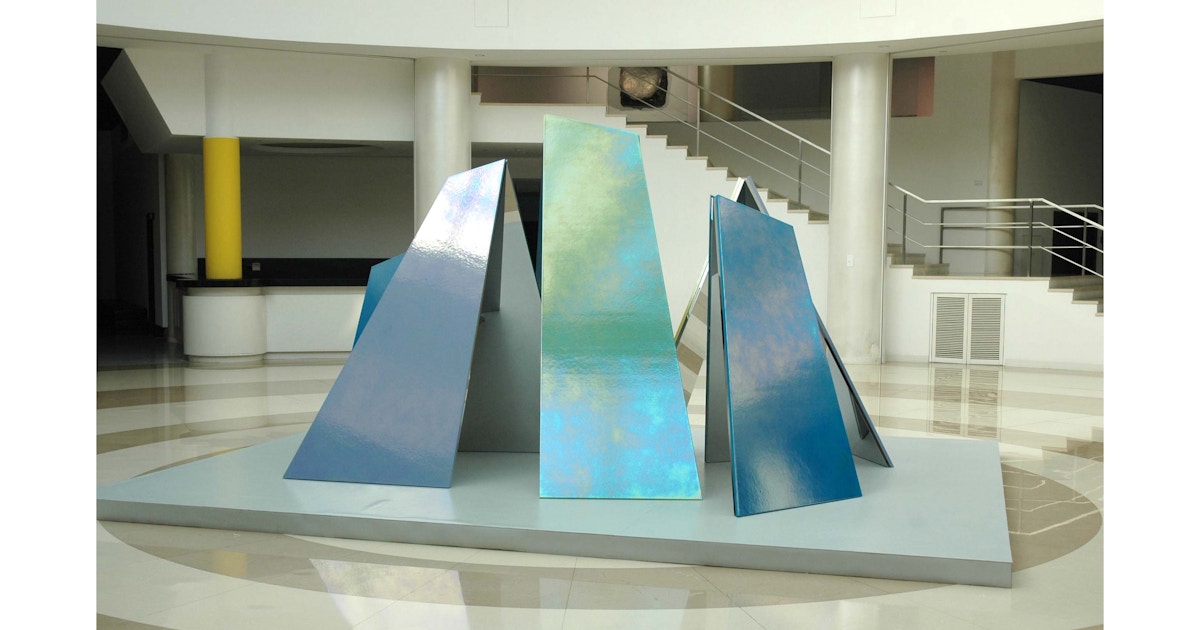
 Image: Museum of Contemporary Art Tokyo, Tokyo
A major retrospective dedicated to Minami Tada will open at the Tokyo Metropolitan Art Museum in Kiyosumi-Shirakawa, Tokyo, marking the first large-scale survey of the artist since her death. Titled 'Minami Tada—Light, Firmly, Shimmering', the exhibition runs from August 29 to December 6, 2026, and will trace roughly 70 years of creative activity through Tada’s sculpture and related works.
Tada, who was active as an abstract sculptor and form artist in postwar Japan, was born in 1924 in Kaohsiung in then Japanese-ruled Taiwan and grew up in Korea. While still in high school, she entered the Chosun Art Exhibition and won an award. She graduated in 1944 from the Western painting department of the Joshibi School of Art, later known as Joshibi University of Art and Design, and continued to show paintings in major postwar exhibitions, including the 41st Nika Exhibition in 1956 and the 9th Yomiuri Independent Exhibition in 1957. In 1957, she produced the relief 'Coal Mine' for the Coal Labor Hall, and in 1962 she founded the Minami Tada Research Institute.
The exhibition positions Tada as one of the early adopters of industrial materials and fabrication techniques in art during Japan’s period of rapid economic growth. Her works are described as surfaces that avoid visible traces of handwork while incorporating light’s reflection, transmission, refraction and movement. Rather than emphasizing mass and stability in the manner of academic figurative sculpture, her practice pursued relationships with space, environment and the viewer’s movement, placing her among important postwar developments in abstract form-making.
Over her career, Tada produced about 200 sculptures and nearly 500 works related to architecture. Her work extended well beyond museum settings into public and civic spaces, including parks, train stations, city halls, hotels and theaters. The survey will present this wide range of practice, from stainless-steel sculptures that seem to rise toward the sky to glass and acrylic works that blend with natural scenery, as well as illuminated works she called 'light forms'.
According to the museum, the exhibition will occupy about 1,500 square meters of underground gallery space, including an atrium lit by natural light, as well as an adjacent outdoor display area. Around 70 works will be shown, including early paintings, sculptures from different periods, and lighting works such as chandeliers, alongside archival materials including architectural components, photographs and sketches. The presentation is designed to span the full scope of Tada’s artistic activity across art, architecture and design.
With the cooperation of the Minami Tada Research Institute, the museum will also recreate or reconstruct selected works that no longer exist or that were inseparable from buildings. Among them is 'Chaindelier' from 1963, a chandelier made from the ball chain used in washbasins, which became a landmark work and led to Tada’s commission for the light forms of the Imperial Palace’s new state rooms. The exhibition will also reconstruct part of 'Zuiun' from 1973, originally made for the Rihga Royal Hotel Osaka, using about 3,000 crystal-glass parts from the time of its creation. To mark the exhibition, talks by researchers and specialists are also planned.