 Image: Rubin Museum of Art
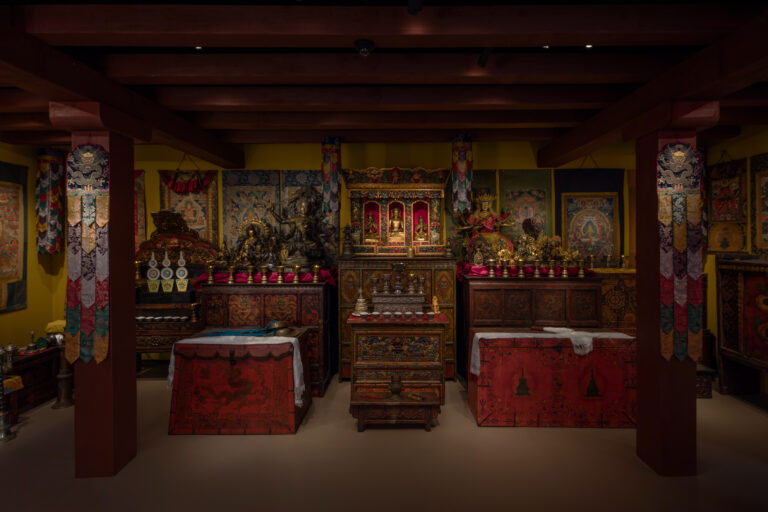
The Rubin Museum of Art is marking the one-year anniversary of its Tibetan Buddhist Shrine Room at the Brooklyn Museum, where the installation has now been on view for a year following its move from Manhattan. The Shrine Room, first introduced in 2013, has long been one of the Rubin’s best-known offerings, and the institution says it is intended to give visitors an immersive encounter with Tibetan Buddhist devotional space rather than a conventional display of single objects.
The installation is located on the second floor of the Brooklyn Museum’s Arts of Asia galleries and is scheduled to remain there through April 20, 2031. According to the Rubin, the Shrine Room presents more than 100 artworks and ritual objects arranged to represent a Tibetan Buddhist household shrine, a setting used for prayer, offerings, and ritual practice. The museum describes the current version as following the Geluk Tibetan Buddhist tradition, with scroll paintings, sculptures, furniture, ritual implements, and musical instruments selected to reflect that lineage.
The Rubin says the Shrine Room was exhibited in Manhattan from 2013 to 2024, where more than one million people experienced it before the Rubin’s galleries closed. Its relocation to Brooklyn is part of a six-year collaboration between the Rubin and the Brooklyn Museum designed to preserve public access to Himalayan art in New York City. The museum’s exhibition page emphasizes that the display is meant to situate religious art in cultural context, incorporating traditional Tibetan furniture and elements of Tibetan architecture and home design.
That context is central to the work’s significance. Rather than presenting Himalayan art as isolated masterpieces, the Shrine Room frames objects within living devotional traditions. The Rubin’s materials note that Tibetan Buddhist shrine rooms can be found throughout the greater Himalayan region and in Buddhist communities around the world, ranging from humble household altars to ornate temple spaces. In that sense, the installation functions not just as an art display but as a reminder that these objects belong to rituals, lineages, and everyday religious practice.
The one-year anniversary also arrives alongside a broader slate of Rubin activity in New York City and beyond. The museum is participating in West Side Fest 2026 with programs on July 11 and 12, including a lecture and guided meditation on the High Line and a family art workshop at Little Island. Elsewhere, the Rubin is continuing its public-facing projects through its Mandala Lab programming and a public sculpture by IMAGINE (a.k.a. Sneha Shrestha) at Diversity Plaza in Jackson Heights, both of which underscore the institution’s emphasis on making Himalayan art and ideas accessible outside the museum wall.
For the Rubin, the Shrine Room’s anniversary is a reminder of how a single installation can anchor a larger mission. By keeping a major work of collection-based cultural interpretation on long-term view in Brooklyn, the museum is extending the reach of its Himalayan art holdings while offering visitors a sustained encounter with a tradition often misunderstood outside its communities of practice. In an art world increasingly focused on access, context, and public partnership, the Shrine Room remains a notable model of how an institution can preserve continuity while moving its core experience into a new home.