 Image: Canadian Museum of Contemporary Photography, Ottawa
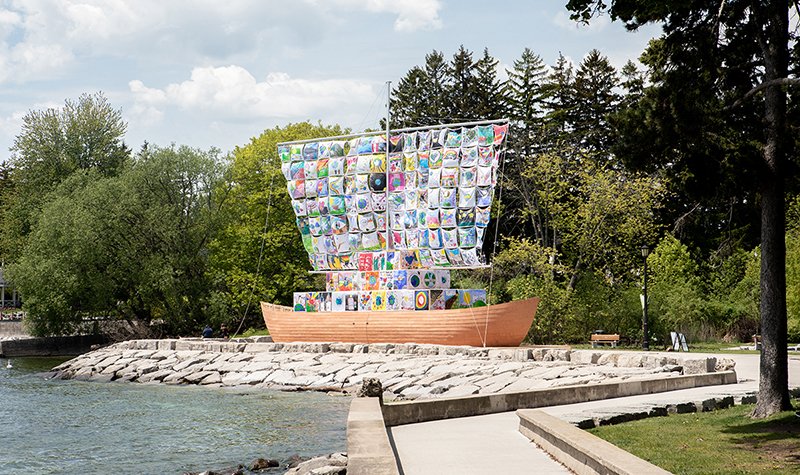
Ilya and Emilia Kabakov’s ‘The Ship of Tolerance’ is being presented as a nomadic installation built around participation, local collaboration and children’s workshops, according to a National Gallery of Canada magazine essay published July 2. The sculptural project takes the form of a wooden vessel and has, since its launch in 2005, been described by the artists as a way to “educate and connect the youth of different continents, cultures, and identities through the language of art.” Each iteration brings together local communities and young participants whose drawings and stories become part of the work itself.
In the Gallery’s account, the project extends the Kabakovs’ longstanding interest in narrative environments while shifting that language into a more openly public and collaborative mode. Earlier solo works by Ilya Kabakov, associated with Moscow Conceptualism, used what he called large-scale “total installations” to immerse viewers in fictional worlds shaped by communal apartments, bureaucratic offices and other constructed settings. ‘The Ship of Tolerance’ replaces those fictional inhabitants with real participants, and the drawings made in workshops literally form the fabric of the installation.
The article situates that shift within the Kabakovs’ broader trajectory from Soviet “unofficial” art to internationally circulating installation work. It cites art historian Peter Osborne and Norwegian critic Line Ulekleiv in describing how collaboration became a defining feature of the pair’s post-Soviet practice. In this reading, the work’s public dimension is not secondary to its form: the installation is treated as a setting for shared discussion about acceptance, respect and collective responsibility.
The version discussed in the essay was reconstructed for the first time in Canada in May 2025 as an ambitious collaborative effort involving Oakville Galleries and the National Gallery of Canada through the latter’s National Engagement program. Rather than linking children from multiple countries, as some earlier iterations did, the Oakville project was rooted in local partnerships. Educators from regional schools worked with the artists and project team to facilitate workshops for more than 2,000 children ages 6 to 15.
Those workshops asked participants to consider questions including respect, environmental concerns and the pressures of social media, and to respond with creative proposals and drawings. The children’s contributions were then sewn together into a multi-coloured sail, described in the article as a “collage of hopes and dreams for a better future.” The piece is modelled on an ancient Egyptian wooden vessel, and the Oakville version continued the project’s emphasis on making the installation a living, changing object rather than a fixed monument.
The article also emphasizes the work’s local specificity. Alongside regional schools, the installation involved young singers and drummers from the Mississaugas of the Credit First Nation and arts charity ArtHouse Halton. The artists’ approach, the essay argues, shows how the project adapts to each place while keeping a consistent structure of youth participation, collaborative making and social reflection.
A further section of the essay focuses on the contested meaning of tolerance itself. In a recent conversation quoted by the National Gallery, Emilia Kabakov said that tolerance is understood differently across cultural and political settings. The article notes that in Moscow, officials resisted the title ‘The Ship of Tolerance’ because the word had been associated with activism around socially contentious issues such as LGBTQIA+ rights, while another partner objected because the term was seen as an unnecessary criticism of their society. The installation is presented until September 30, 2026 at Gairloch Gardens by Oakville Galleries, in partnership with the Ilya and Emilia Kabakov Foundation and the National Gallery of Canada, as part of the National Gallery’s National Engagement initiative.