 Image: Gallery U, Montevideo
A small-gallery retrospective of Frederick Lynch is on view in Woolwich through Aug. 16, bringing together work that maps the artist’s shifting approaches from the 1980s through his later figurative abstractions. The presentation at Sarah Bouchard’s gallery is among three Maine-focused shows reviewed this week, and it concentrates on an artist who worked through a long sequence of formal transitions before his death in 2016.
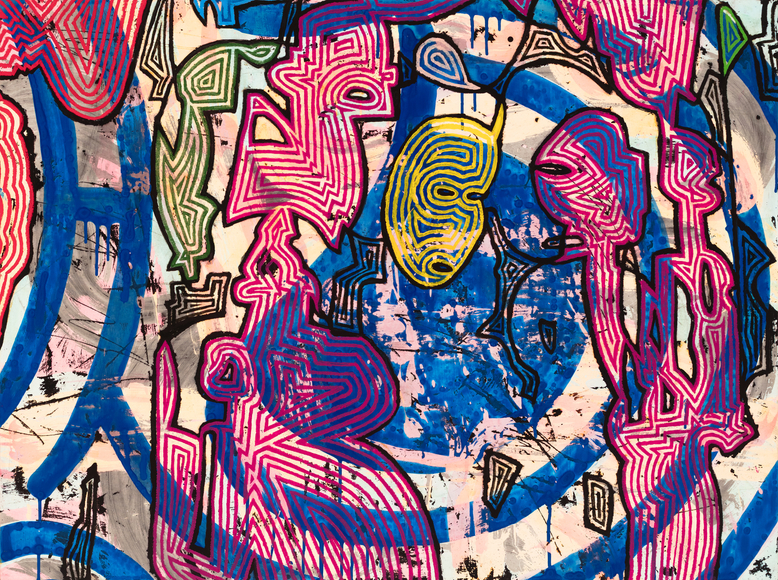
According to the review, Bouchard has “done an admirable job” of hitting key touchstones in Lynch’s career, beginning with two etchings from the 1980s. From there, the installation moves to colorful, pattern-based works from 1988, two of which are included. Those paintings mark a major step in Lynch’s development: they break up the rectangle into smaller segments, a structural idea that would become central to his later work. The 1988 pieces are described as collage-like in composition, with an interplay of architecture and landscape, while remaining clearly abstract and carrying a Pop-like flavor.
The review emphasizes Lynch’s saturated color mixing as one of the works’ most striking qualities, noting the dimensionality it gives each element of the compositions. That concern with division and segmenting continues to thread through the exhibition. By 1994-95, Lynch’s ‘Rotoform’ paintings take that color saturation into circular canvases that feel looser and more freeform, and the shift is framed as a substantial and sensual departure from the earlier rectangle-based works.
The retrospective then turns to Lynch’s ‘Division’ paintings from the 2010s, in which the artist returns to segmentation with renewed intensity. The review cites a 2010 studio-visit quotation, in which Lynch described the work as reflecting his fascination with the “idea that repeated sectoring of a given area can produce infinite shape variations.” One highlighted work, ‘Division Piece #74’ from 2013, is described as a highly intricate geometric image made by gouging a lace-like pattern into melamine, inking it, and wiping away the excess.
From there, the exhibition focuses on Lynch’s ‘Divided Man’ paintings and ink drawings. The largest work discussed, ‘Divided Man 32 — Earthly Only,’ layers three patterns to depict a male figure that seems almost transparent, built from filigree-like structure rather than solid form. Several gouache-on-paper versions are also included, showing the same concern with pattern and human presence, and suggesting, in the reviewer’s reading, an image of existence embedded in a larger matrix.
The final works in the show are ink drawings and self-portraits from 2016, the year Lynch died of cancer. The review notes that in these drawings he seems to become “the matrix itself,” with contours that expand beyond normal human limits. One drawing, ‘Divided Man Drawing #9,’ is singled out for a lighter note: Lynch’s spectacles are left free of subdivision and patterning, making him resemble the Invisible Man from the 1933 sci-fi film. The exhibition is on view at Sarah Bouchard’s gallery in Woolwich through Aug. 16.