 Image: Gallery 9, Los Altos, Long Beach
Gallery 98 has recently acquired a collection of original Guerrilla Girls posters from the 1980s, adding to the circulation of work that helped define feminist street art and art-world critique in that decade. The posters, made by the anonymous collective, are presented as part of the group’s early campaign of wheatpasted images and statistics aimed at exposing gender and racial disparities in the art industry. The material now sits within a broader history that has seen sets of Guerrilla Girls posters enter contemporary art museums around the world.
Among the works highlighted in the collection is 'Guerrilla Girls’ Identities Exposed!', a 1990 poster that the source describes as embedding the names of over 500 art-world supporters. The poster also carries the group’s long-standing insistence on anonymity, which it used both as protection in a confrontation with the art establishment and as a way to underscore collective authorship. The source notes that at the beginning there were seven members, though over time more than one hundred artists have participated.
The collection also includes 'What Do These Artists Have in Common?', from 1985, described as the group’s very first poster. In that work, the Guerrilla Girls listed the names of famous male artists represented by galleries that showed less than 10 percent women artists. The cited artists include Jean-Michel Basquiat, Keith Haring, Claes Oldenburg, Julian Schnabel, Chuck Close, Bruce Nauman, Eric Fischl and Robert Ryman. The poster’s premise was direct: to confront the art world’s skewed representation by naming artists connected to galleries with strikingly low percentages of women.
The source text places the posters in the context of the group’s first wheatpasting campaign in Soho and Tribeca in 1985, when the Guerrilla Girls introduced a new form of politicized street art that had an almost immediate effect. It also emphasizes that the posters were more than political fly-posters. Because they were made by artists, at a moment when many artists wanted to create work that effected social change, the source argues that the posters can be understood as fine art as well as activism. Their status is linked to the role of posters and ephemera in documenting performance and street art.
The Guerrilla Girls’ early output was prolific. The source says the group produced and distributed thirteen posters in 1985 and 1986 alone, using attention-grabbing statistics and often sarcastic humor to challenge art-world institutions. By 1987, their focus had widened beyond women artists to include artists of color, as seen in 'What’s Fashionable, Prestigious and Tax-Deductible', which named funders such as the National Endowment for the Arts, Philip Morris Companies, Chase Manhattan Bank and the Lauder Fund, while also identifying curators including Kynaston McShine of MoMA and Lisa Phillips, then at the Whitney Museum.
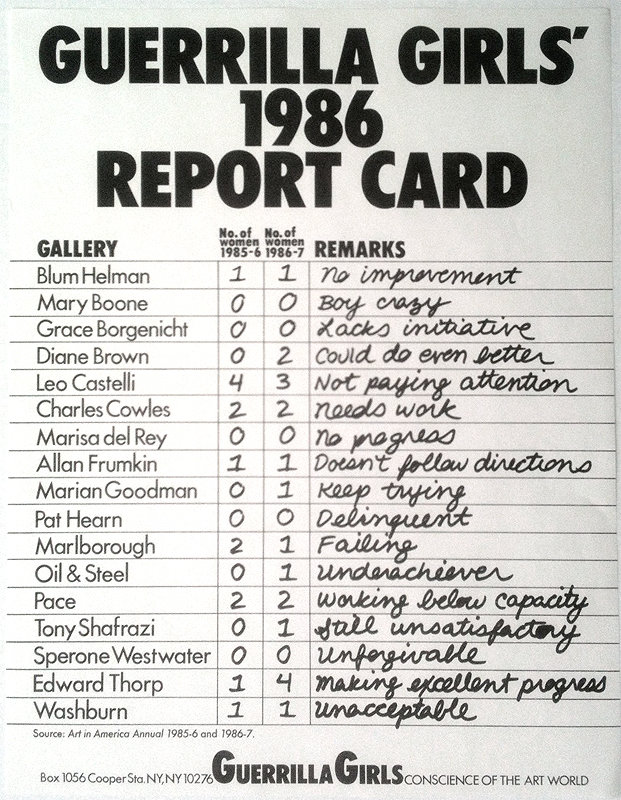
The collection also includes 'Guerrilla Girls’ Report Card', from 1986, and 'Guerrilla Girls Urge Drastic N.E.A. Cuts!', from 1989, the latter responding to the legislative climate following Senator Jesse Helms’s proposed amendment affecting NEA funding for art deemed obscene or disrespectful. Another key work in the group’s best-known output is 'Do Women Have to Be Naked To Get Into The Met. Museum', from 1989, which the source identifies as by far their most popular poster. When the Public Art Fund refused to fund it, the Guerrilla Girls rented advertising space on New York City buses themselves and also printed additional posters on the paper they used for wheatpasted wall posters. Gallery 98’s newly acquired posters are presented as part of that larger, still-circulating record of activist print work.