 Image: Nasher Museum of Art, Durham
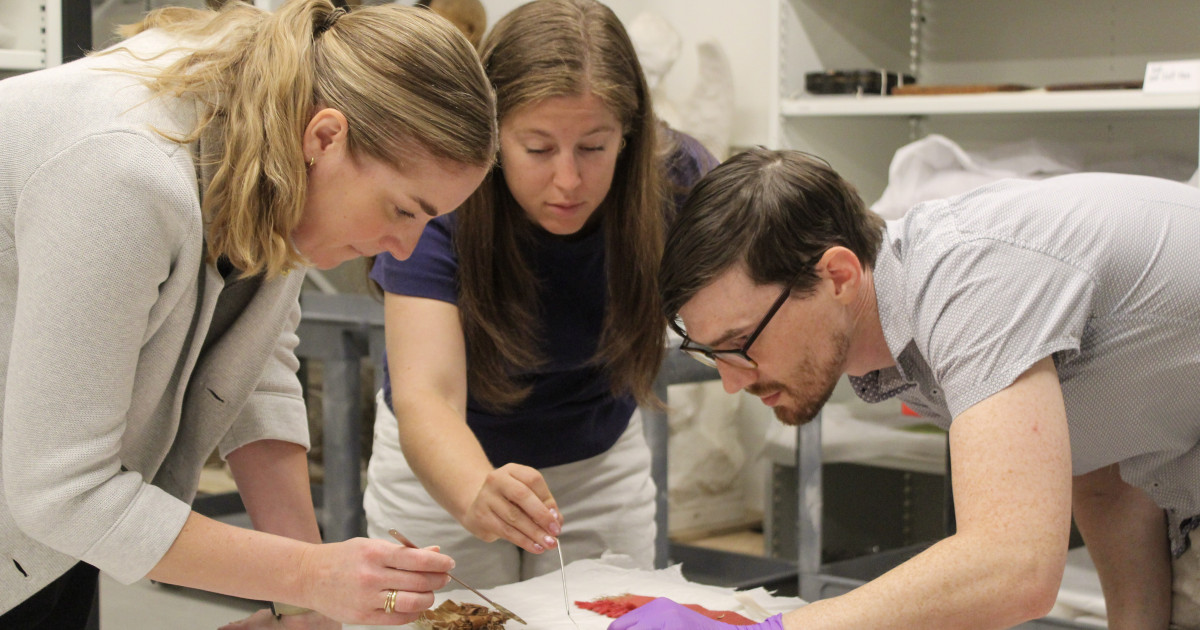
A team of Duke chemists is investigating the origins of ancient textiles in the Nasher Museum of Art’s collection, where some objects have origin stories that remain mysterious. The project includes pieces about which the museum itself previously had limited information.
The researchers are using pump-probe microscopy, an advanced imaging technique that uses ultrafast laser pulses to examine the textiles’ pigments. The method allows them to get a deep look at the colorants without harming the textile fibers.
Chemistry Ph.D. student Anna Sheinberg is working with Julia McHugh, a curator at the Nasher Museum of Art, to study ancient textiles from present-day Peru. Their focus is specifically on pieces dyed with cochineal. Cochineals are small insects that live on prickly pear cacti native to Mexico and South America. Indigenous communities have harvested the insects for thousands of years to produce vibrant red dyes.
McHugh hopes the research will confirm that the textiles are cochineal-dyed and help narrow down how and when they were first made. Information gleaned from the imaging can also help researchers better understand the textiles’ heritage and inform conservation.