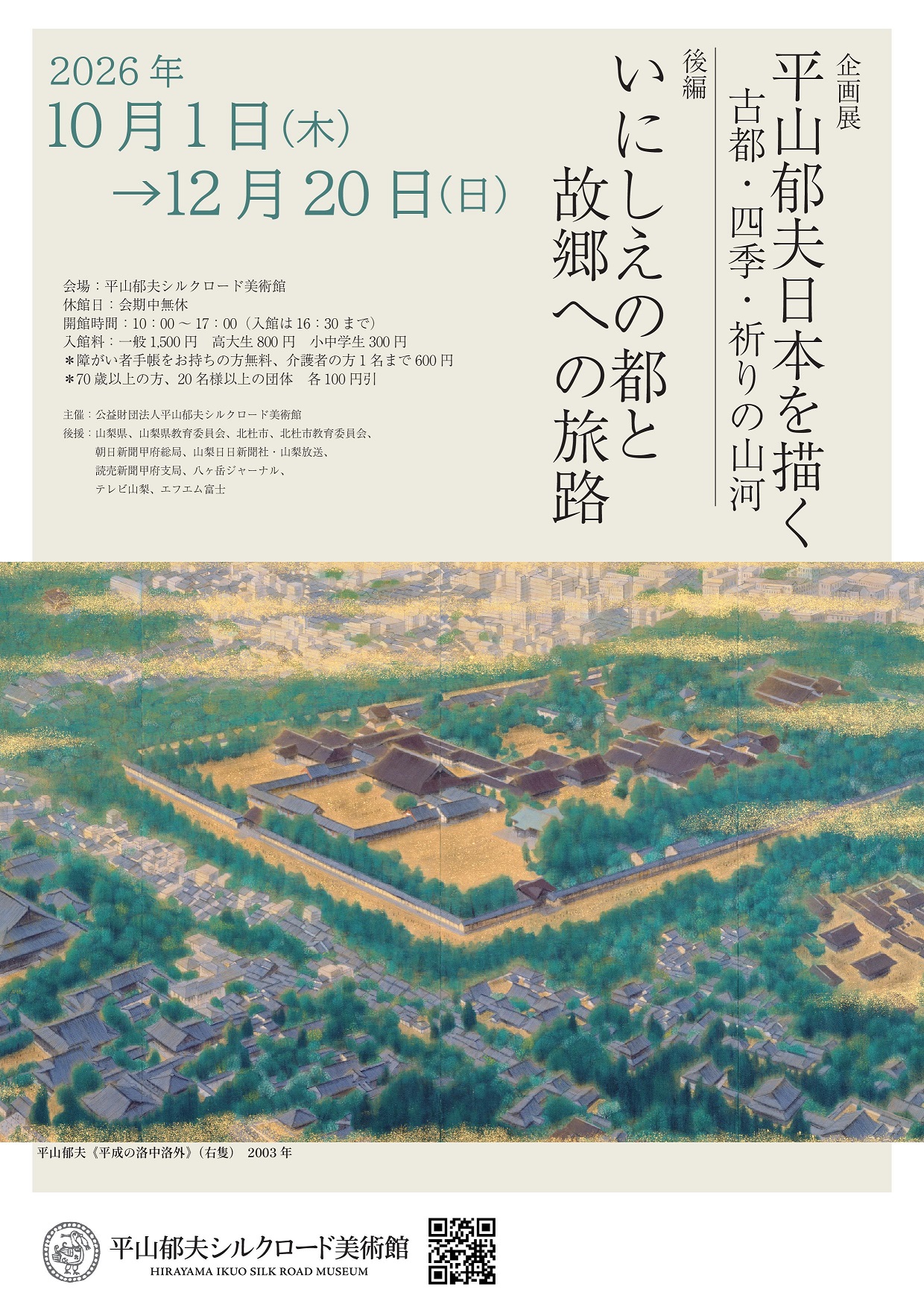
 Image: Hirayama Ikuo, Heisei no Rakuchū Rakugai (Kyoto In and Around the Capital in the Heisei Era), right screen, 2003
The Hirayama Ikuo Silk Road Museum in Hokuto, Yamanashi Prefecture, has opened the second part of its two-part exhibition Hirayama Ikuo: Painting Japan – Ancient Capitals, Seasons and Sacred Landscapes. Subtitled Journeys to the Old Capitals and His Hometown, this instalment runs until 20 December 2026 and is open every day of its run, from 10:00 to 17:00 with last entry at 16:30.
Where the series as a whole surveys how Hirayama depicted Japan, this second part concentrates on places tied to the country's historic capitals and to the painter's own origins. It brings together his views of Kyoto, both within and beyond the old city limits, the ancient temples of Nara, the landscapes of Kamakura, and scenes of Setoda, his hometown. The museum presents the selection as Japanese landscapes that Hirayama came across on his travels and held on to in memory, and has timed it for the passage from autumn into winter.
The work chosen for the exhibition's promotional material is the right-hand screen of Heisei no Rakuchū Rakugai (Kyoto In and Around the Capital in the Heisei Era), painted in 2003. It shows a walled compound seen from above, set among dense green trees and the rooftops of the surrounding city under a haze of gold.
The exhibition is organised by the foundation that runs the museum, with the support of Yamanashi Prefecture, Hokuto City, their boards of education and a group of regional newspapers and broadcasters.