 Image: Mary and Leigh Block Museum of Art, Evanston
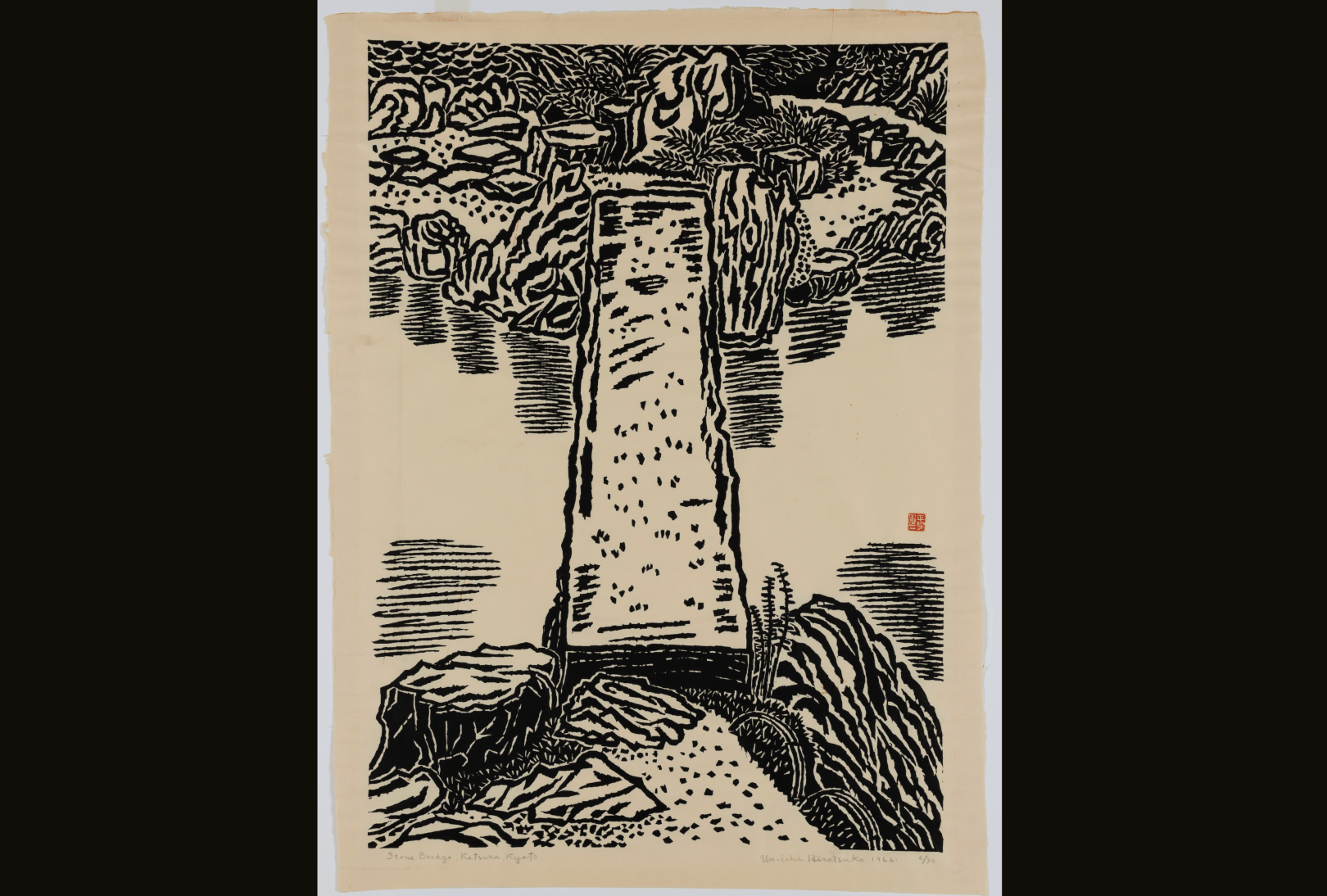
The Mary and Leigh Block Museum of Art at Northwestern University has published a close study of Stone Bridge, Katsura, Kyoto, a 1966 woodblock print by Hiratsuka Un’ichi (1895–1997) from its collection. The sheet measures 33½ by 25 inches and entered the museum in 1985 as a gift of Mr. and Mrs. Theodore Van Zelst. The text is by Aja Frazier, the museum’s 2025–2026 curatorial intern.
The print depicts the Shirakawa Bashi, a stone crossing in the gardens of the Katsura Imperial Villa in Kyoto that leads toward the Shōkintei, the villa’s most prestigious teahouse. Hiratsuka leaves the teahouse out altogether. He places the bridge at the centre of a symmetrical composition, tilts the viewpoint sharply downward and exaggerates the foreshortening, so that the eye is pulled onto the span itself. Short, heavy cuts render weathered stone, furrowed bark and gritty soil, while an uncut white band in the middle ground stands for still water. The artist’s seal supplies the only colour on an otherwise black-and-white sheet.
Hiratsuka sketched the bridge during a visit to the villa in 1960. The gardens were laid out between 1615 and 1662 under a prince and later his son, who drew on The Tale of Genji for their design. The museum notes that it is unknown why the artist chose this modest bridge over the garden’s grander features.
Born in Matsue into a family of carpenters and shrine builders, Hiratsuka left business school to pursue art. From 1913 he studied with the Western-style painter and printmaker Ishii Hakutei, who introduced him to the block cutter Igami Bonkotsu, with whom he then apprenticed. During the 1920s he travelled around Japan teaching woodblock printing and met leading figures of sōsaku hanga, the “creative print” movement, whose artists handled every stage of production themselves and combined Japanese and Western methods. The museum describes him as a mentor to several of its best-known practitioners.
In the mid-1930s, while teaching the first woodblock printing course at the Tokyo School of Fine Arts, he moved away from fine-lined colour prints toward darker, bolder forms. He developed a technique known as tsukibori, or “poking strokes”, cut with a small square-ended chisel, and after the Second World War worked only in black and white.
In 1962 Hiratsuka travelled to Washington, D.C., to join his wife at their daughter’s home and remained there for more than 30 years. According to the museum, he received commissions there for prints of landmarks including the Lincoln Memorial, the Washington Monument and the Library of Congress. Japan awarded him the Order of the Sacred Treasure, Third Class, in 1970, and a museum dedicated to his prints opened in Nagano in 1991.