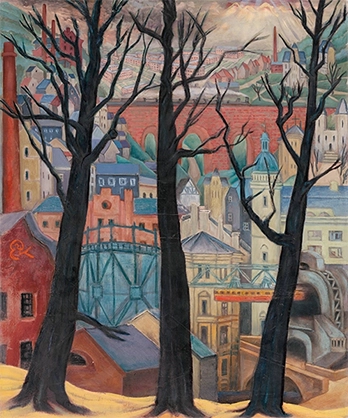
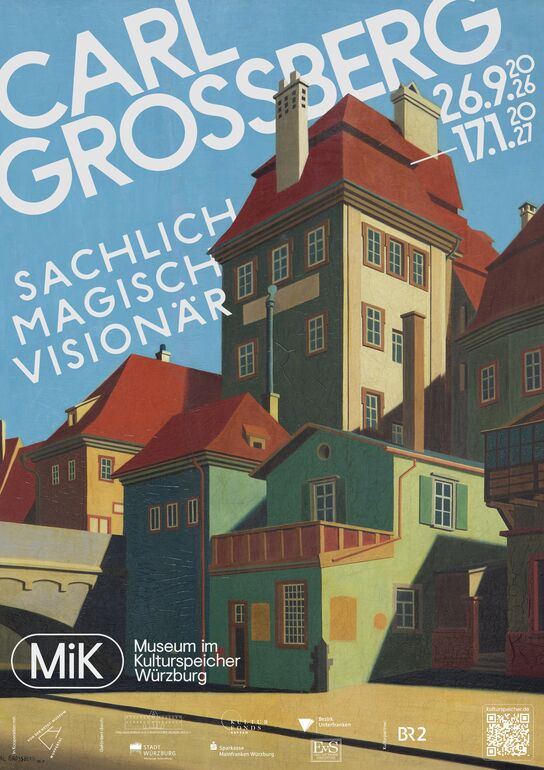
The Von der Heydt Museum in Wuppertal is showing 'Carl Grossberg. Sachlich – magisch – visionär', an exhibition that presents the work of Carl Grossberg as a major rediscovery of a leading figure of Neue Sachlichkeit. On view until 30 August 2026, the retrospective surveys an artist whose compact career, spanning just under 20 years, was devoted almost entirely to architecture and industry.
The museum describes the show as the first retrospective on Grossberg in more than 30 years. According to the exhibition text, it brings together a number of previously unknown works and reconsiders his output in both artistic and social terms. Grossberg, born in Elberfeld in 1894 and active in the early decades of the 20th century, is presented here as a painter whose formal clarity and strictness reflect a photographic way of seeing and the technological progress of the period.
The exhibition focuses on his depictions of industrial landscapes, buildings and urban views, alongside the more open-ended 'Traumbilder' that the museum identifies as especially distinctive within the art of the 1920s and 1930s. The presentation emphasises the tension in Grossberg’s work between precision and ambiguity, noting that his reduced compositions invite viewers to question industrial progress and its effects on people. A catalogue for the exhibition is available in the museum shop and is presented as the first German-language book on Grossberg in 30 years.
The museum also places Grossberg in dialogue with photography, pointing to the shared visual language that shaped his motif choices and the austerity of his painting. The exhibition text says this connection influenced later photographers, and names August Sander, Bernd and Hilla Becher, and Thomas Ruff among the examples used to make that point. The display also notes that Grossberg’s images meet a fundamentally different media environment today, one defined by rapidly produced, digitally circulated and manipulated pictures.
The Von der Heydt Museum is mounting the exhibition in cooperation with the Museum im Kulturspeicher Würzburg (MiK). The institutions say both are closely tied to Grossberg’s biography: he was born in Wuppertal and lived from 1921 in Sommerhausen, south of Würzburg, and is represented in the collections of both houses.
The museum has also tied the exhibition to a wider programme of guided tours and workshops. Public tours are offered on Tuesdays at 11.30 am and Sundays at 3.30 pm, with a themed Wednesday tour on 5 August titled 'Carl Grossberg und seine neusachlichen Architekturbilder und Veduten'. A curator-led tour is scheduled for Thursday, 27 August at 4.30 pm with Dr. Roland Mönig. Family and children’s activities include 'Magische Tierwelt' on 30 August, 'Farbenstadt im Sonnenlicht' on 23 August, and the two-day course 'Gemeinsam weben, durch Wuppertal schweben' in cooperation with the Bandwebermuseum.