 Image: The Bookstore, National Gallery of Canada, Ottawa
The National Gallery of Canada’s Library and Archives has published a magazine feature on the group of official Canadian postage stamps in its ephemera collection that reproduce works by artists also held in the Gallery’s own collection. Written by Jane Robertson, an assistant in the Library and Archives, and published on 26 August 2026, ‘Miniature Marvels: Art and Stamps’ looks at stamps after Kenojuak Ashevak, Emily Carr, Marcelle Ferron, Prudence Heward and Daphne Odjig.
The holdings are described as a cluster of official, never-hinged imprints within an ephemera collection that reflects the growth of the mail art and correspondence art movements, when images were being duplicated and circulated at speed through networking and gift-giving. Several of the stamps can be paired with the original work in the Gallery’s collection. The article notes the standard identification tool, the Scott Standard Postage Stamp Catalogue, and the collecting culture around the format, including The Royal Philatelic Society of Canada; it also distinguishes definitive stamps, in use over many years, from commemoratives issued for a limited period to mark a person or event.
Modern postage is traced to Great Britain’s ‘Penny Black’ of May 1840, followed two days later by the ‘Two Penny Blue’, both bearing a portrait of Queen Victoria. Canada issued its own legal postage stamp, the ‘3-pence Beaver’, on 23 April 1851. The first well-known painting by a Canadian artist to reach a stamp was Emily Carr’s ‘Big Raven’, issued in 1971 for the centenary of Carr’s birth.
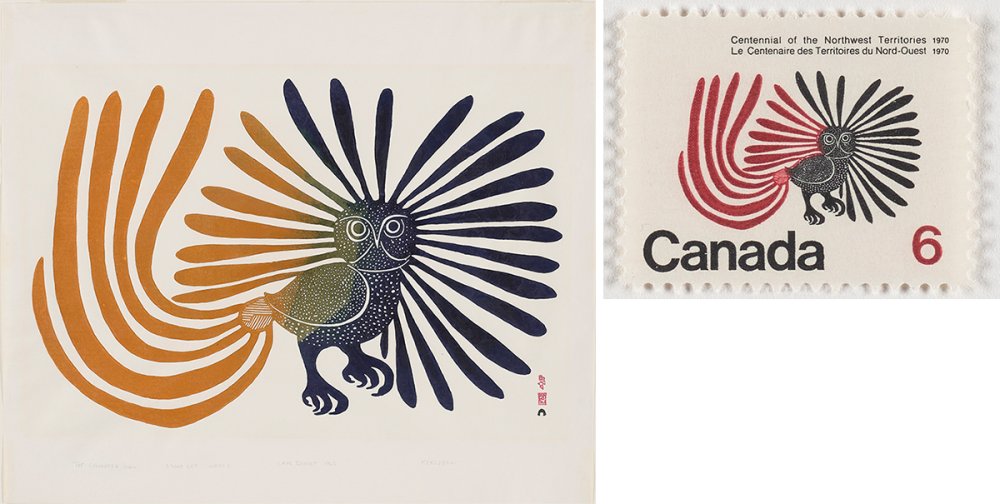
Canadian art began appearing systematically on stamps in the 1960s and 1970s. Kenojuak Ashevak’s colour stonecut ‘The Enchanted Owl’, 1960, was chosen in 1970 to mark the centennial of the Northwest Territories, and has since been called Inuit art’s most recognisable image. Her ‘The Owl’ followed as the sixth issue in Canada Post’s fifteen-part ‘Masterpieces of Canadian Artists’ series, published between 1988 and 2002, released in 1993 to mark the United Nations’ International Year of the World’s Indigenous People.
Marcelle Ferron’s ‘Seafarers’ Union’, 1954, an oil on canvas purchased by the Gallery in 1994, appeared on a stamp in 1998. Ferron was one of sixteen signatories to the Refus global declaration of 1948 and a member of the Automatistes; alongside her painting she worked in stained glass, including the 1968 ‘Verrière’ at Montreal’s Champ-de-Mars Metro station.
The later ‘Art Canada’ series, published between 2004 and 2012, comprised 22 stamps by nine artists. It included Prudence Heward’s ‘Rollande’, 1929, issued as a stamp on 2 July 2010; Canada Post’s own 2010 publication described Heward, a Quebec artist known for her bold depictions of women, as the most acclaimed member of the Montreal-based Beaver Hall Group. The series also carried Daphne Odjig’s ‘Pow Wow (Dancer)’, painted in 1978 and issued as a commemorative on 21 February 2011. Odjig, an Anishinaabe painter and muralist associated with the Woodland School of Art and a contemporary of Carl Ray and Norval Morrisseau, was made a Member of the Order of Canada in 1986.
The stamps and related ephemera remain part of the National Gallery of Canada Library and Archives collections in Ottawa, with opening hours listed on the Library and Archives access page. The article notes that Canadian art stamps can also be seen in the Canadian Stamp Collection gallery at the Canadian Museum of History.