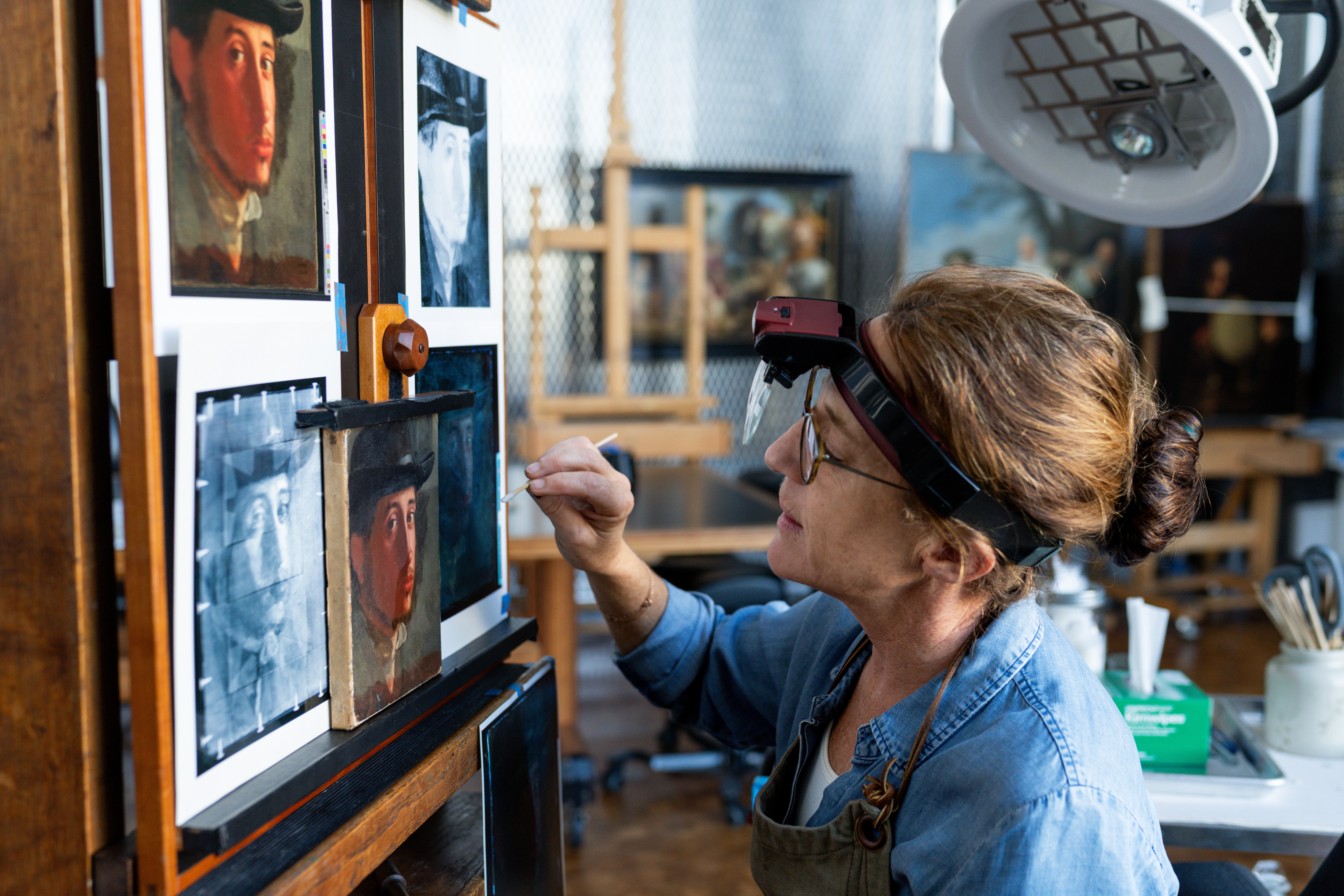
 Image: Getty Museum, Los Angeles
A conservation investigation at the Getty Museum has clarified why Edgar Degas’s ‘Self-Portrait’ developed a cloudy surface while also raising new questions about a reddish layer at the bottom of the small painting. The study, led by Getty Museum Associate Conservator of Paintings Devi Ormond with scientists from the Getty Conservation Institute, examined the work’s condition, materials and likely function as an early artist’s study.
Painted around 1857–58, when Degas was in his early 20s, the portrait measures 8 1/4 by 6 3/8 inches. It is executed in oil on paper laid down on canvas. Ormond first noticed that the surface looked unusual while walking through the museum galleries. The varnish appeared blanched and whitish, a condition she described as disturbing in a work whose intimate scale encourages close inspection.
After consulting Senior Conservator of Paintings Ulrich Birkmaier, Ormond moved the painting to the conservation studio. Examination under a microscope showed a layer beneath multiple varnish coatings that was breaking up and producing the hazy appearance. Ormond removed a synthetic varnish and an older varnish with a mild solvent, revealing residues that appeared to be glue trapped between the brushstrokes.
The glue may have been used either to attach the paper to the canvas or to apply a protective facing to the painted surface. Ormond removed the residues under high magnification with warm water and the tip of a swab. She then applied a very thin, reversible varnish layer and retouched small areas where original paint had been lost. The varnish separates the original surface from the retouching, allowing a future conservator to reverse that work if necessary.
The conservation project also prompted research into Degas’s early self-portraits. Ormond found that the artist produced numerous self-portrait studies during the early part of his career, often on paper and in varying styles. The Getty work has pinholes in all four corners, suggesting that Degas may have pinned it to a board or wall for study. The painting was found in his studio after his death in 1917, and its use of paper would have offered a relatively economical support for a developing artist.
Getty’s account also documents changes made after the artist’s death. The portrait passed through Degas’s family and was eventually inherited by his great-niece, whose estate sold it in 1994. Ormond suspects that a previous conservator adhered the paper to canvas and varnished it around that time, potentially presenting an oil study on paper as a more finished painting. The Getty purchased the work in 1995.
A separate technical question concerned the red area along the portrait’s lower edge. Getty Conservation Institute senior scientist Karen Trentelman and graduate intern Thomas Boers used macro-X-ray fluorescence scanning, which maps the distribution of chemical elements across an artwork. The scan found that the red layer was rich in iron, suggesting the use of a reddish-brown iron-earth pigment. Its purpose remains uncertain. Ormond has proposed that the portrait may have been cut from a larger sheet containing other studies, or that Degas may have been experimenting with a reddish ground inspired by Old Master paintings he encountered during his years in Italy.