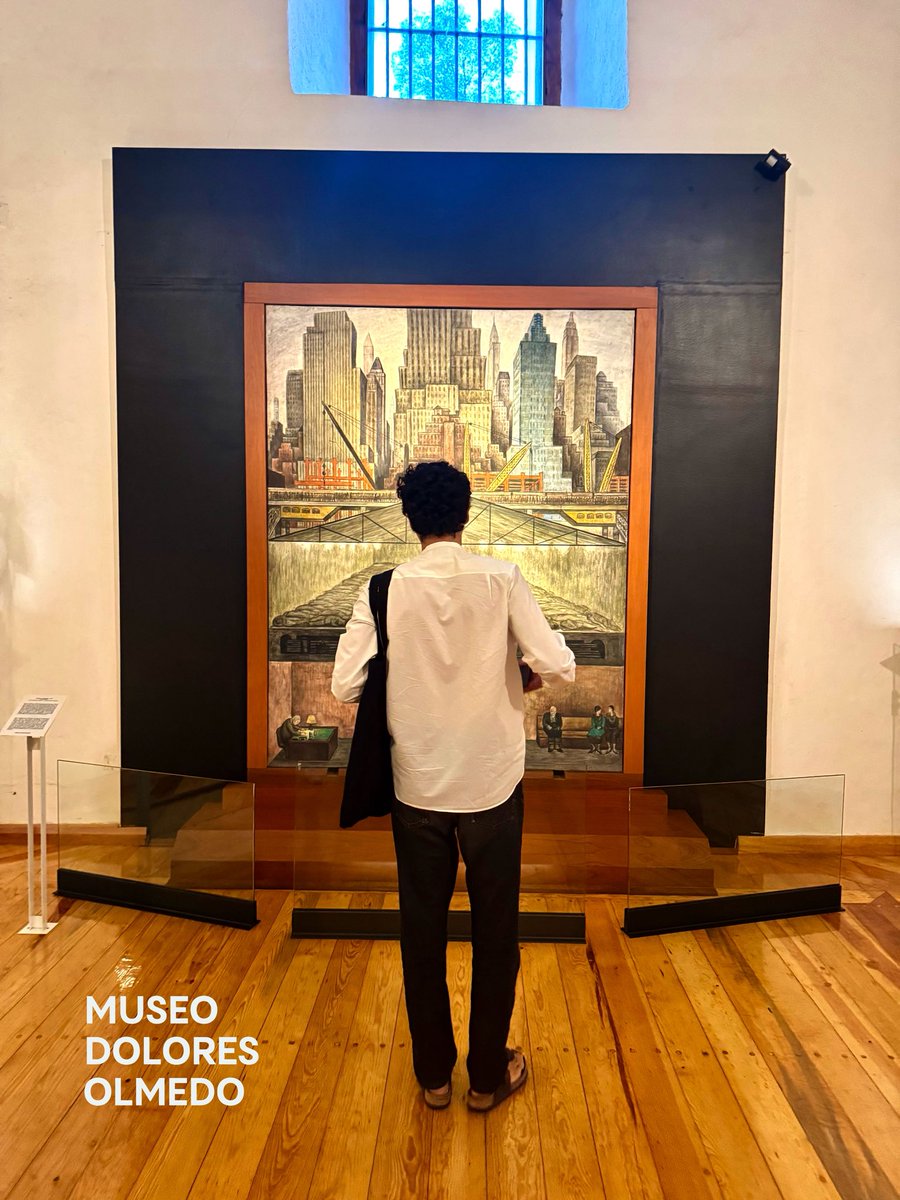
 Image: Museo Dolores Olmedo, Xochimilco
The Museo Dolores Olmedo has highlighted Diego Rivera’s ‘Fondos Congelados’, a work that presents a critical view of capitalism during the Great Depression. The museum’s post describes the painting as a depiction of the modern city divided into three sections, linking its urban imagery to the economic and social tensions of the period.
Rivera painted the work between 1931 and 1932. According to the museum, it was executed in fresco on cement reinforced with a galvanized-steel structure. The stated technique and construction place the work within Rivera’s practice of producing large-scale compositions on durable architectural surfaces.
The museum characterizes ‘Fondos Congelados’ as a “deep critique” of capitalism during the Great Depression. Its three-part structure is presented as central to the work’s visual organization, although the available museum material does not provide further descriptions of the individual sections or identify the figures, settings or symbols depicted in them.
The artwork was the subject of an informational post published by Museo Dolores Olmedo on August 18, 2026. The post was shared through the museum’s social-media presence and directed readers to the institution’s website. The available source does not state that the work is part of a current exhibition, nor does it provide display dates or details of a related public programme.
The Museo Dolores Olmedo is based in Xochimilco, Mexico. In its post, the institution presents Rivera’s work through its historical subject, urban composition and material form, identifying ‘Fondos Congelados’ as a work made during the years 1931–1932 and executed in fresco on cement reinforced with galvanized steel.